
For Muslims who enjoy Korean fried chicken, one common question is “Is Bonchon halal?” The answer is not the same for every country or restaurant location. Bonchon serves fried chicken, beef dishes, seafood, sauces, and other Korean foods. Its official menu also lists pork items, including pork dumplings and pork belly dishes, so Muslims should not assume that every menu item is halal.
In Islam, chicken is generally a halal animal, but the meat must come from a lawful source and proper Islamic slaughter. The sauces, batter, cooking oil, and other ingredients also matter. A chicken dish may not be halal if the meat is not zabiha or if it contains alcohol, pork, or another forbidden ingredient.
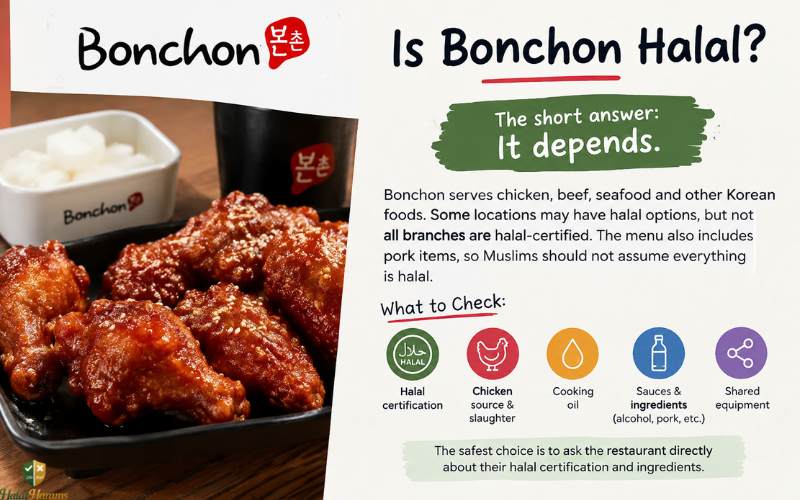
Bonchon’s halal status can also change by location. Some international branches may have halal certification, while others may not. Therefore, Muslims should check the exact branch before ordering.
The safest choice is to ask about halal certification, chicken source, cooking oil, sauces, and shared equipment.
One Line Answer:
Bonchon is not universally halal; its halal status depends on the country and the specific Bonchon branch, so always verify local halal certification before eating.
What Is Bonchon?
Bonchon is a Korean restaurant chain famous for:
- Korean fried chicken
- Soy garlic chicken
- Spicy chicken
- Korean rice dishes
- Korean street food
- Seafood options
- Appetizers and sides
The company originated in South Korea and has expanded to countries across Asia, North America, and the Middle East.
Bonchon’s popularity comes from its unique cooking process, which involves double-frying chicken to create a crispy texture.
Is Bonchon Halal?
The halal status of Bonchon depends on the location.
Some Bonchon restaurants operate with halal-certified ingredients, while others do not.
Therefore:
- Some locations are halal-certified.
- Some locations are not halal-certified.
- Some locations use halal chicken but lack certification.
- Some locations serve alcohol alongside food.
Because practices vary significantly, Muslims should verify the status of the specific restaurant they plan to visit.
General Bonchon Halal Status
| Location Type | Halal Status |
|---|---|
| Halal-certified branch | ✅ Halal |
| Branch using halal chicken | Usually acceptable if verified |
| Non-certified branch | Requires verification |
| Branch serving non-halal meat | ❌ Not halal |
| Branch with uncertain sourcing | Verify before dining |
The restaurant’s location plays a major role in determining halal compliance.
Why Bonchon’s Halal Status Varies
Unlike some restaurant chains that use a single global supplier, Bonchon often relies on regional sourcing.
Factors affecting halal status include:
- Local food regulations
- Country-specific suppliers
- Franchise ownership
- Halal certification requirements
- Ingredient availability
As a result, two Bonchon restaurants in different countries may have completely different halal statuses.
Related Post: Is Squid Halal
Is Bonchon Halal in Muslim-Majority Countries?
In many Muslim-majority countries, Bonchon locations often adapt to local requirements.
Some branches may:
- Use halal-certified chicken
- Obtain halal certification
- Follow local halal regulations
- Avoid non-halal ingredients
Examples may include locations in:
- Malaysia
- Indonesia
- Saudi Arabia
- United Arab Emirates
However, Muslims should still confirm the certification status of each location.
Is Bonchon Halal in the United States?
Most Bonchon restaurants in the United States are not widely advertised as fully halal.
Common concerns include:
- Chicken sourcing
- Cross-contamination
- Alcohol-containing menu items
- Lack of halal certification
Some individual franchise locations may offer halal chicken, but this is not universal across all U.S. branches.
Verification is strongly recommended before ordering.
Is Bonchon Halal in Canada?
Similar to the United States, halal status varies by location.
Some Canadian branches may:
- Source halal meat
- Display halal certification
- Follow halal preparation standards
Others may not.
Muslim customers should contact the restaurant directly for the most accurate information.
Bonchon’s Chicken and Halal Requirements
For chicken to be halal, Muslims generally expect:
- Halal-certified sourcing
- Proper Islamic slaughter
- Compliance with halal standards
- Prevention of contamination with haram ingredients
If Bonchon cannot verify these requirements, many Muslims may choose to avoid chicken menu items.
Halal Chicken Requirements
| Requirement | Importance |
|---|---|
| Halal-certified supplier | High |
| Proper slaughter method | High |
| Ingredient verification | High |
| Cross-contamination control | High |
| Certification documentation | Helpful |
These factors help determine whether chicken can be considered halal.
Does Bonchon Serve Pork?
Some Bonchon locations may offer menu items containing pork or pork-derived ingredients.
Examples may include:
- Pork appetizers
- Pork toppings
- Specialty dishes
Because pork is clearly prohibited in Islam, Muslims should always review menu ingredients carefully.
See Also: Is Olive Garden Halal
Alcohol Concerns at Bonchon
Another important consideration is alcohol.
Some Bonchon restaurants serve:
- Beer
- Wine
- Alcoholic beverages
Additionally, certain sauces or marinades may contain alcohol-derived ingredients depending on the region.
Muslim diners should verify:
- Sauce ingredients
- Marinade ingredients
- Cooking methods
The presence of alcohol in a restaurant does not automatically make all food haram, but ingredient verification remains important.
Are Bonchon Sauces Halal?
Bonchon’s famous sauces contribute significantly to its popularity.
Common flavors include:
- Soy garlic
- Spicy Korean sauce
- Sweet and spicy glaze
The halal status of these sauces depends on:
- Flavoring ingredients
- Vinegar sources
- Alcohol content
- Manufacturing process
Most sauces may be acceptable, but verification is still recommended.
Seafood Options at Bonchon
Many Bonchon restaurants offer seafood dishes.
Examples include:
- Shrimp
- Fish
- Seafood appetizers
Seafood often presents fewer halal concerns than chicken or beef.
However, Muslims should still verify:
- Cooking oils
- Sauces
- Shared fryers
Preparation methods can affect the halal status of seafood dishes.
Bonchon Menu Categories
| Menu Item | Halal Consideration |
|---|---|
| Chicken | Verify certification |
| Seafood | Check preparation |
| Rice dishes | Review ingredients |
| Sauces | Verify contents |
| Appetizers | Check for pork or alcohol |
Every menu category deserves careful review.
Related Post: Is Balsamic Vinegar Halal
Cross-Contamination Concerns
Cross-contamination occurs when halal food comes into contact with non-halal substances.
Potential sources include:
- Shared fryers
- Shared utensils
- Shared preparation stations
- Shared storage areas
Even if halal chicken is used, some Muslims prefer restaurants that maintain strict separation procedures.
How to Verify Bonchon’s Halal Status
The safest approach is to contact the restaurant directly.
Questions to ask include:
- Is the chicken halal-certified?
- Which certification body approves the meat?
- Are halal certificates available?
- Are separate preparation areas used?
- Do sauces contain alcohol?
Restaurant management can usually provide the most accurate information.
Halal Certification and Bonchon
Halal certification is one of the most reliable indicators of compliance.
Certification generally verifies:
- Ingredient sourcing
- Processing methods
- Slaughter practices
- Facility standards
Benefits of Halal Certification
| Benefit | Importance |
|---|---|
| Consumer confidence | High |
| Ingredient verification | High |
| Slaughter compliance | High |
| Independent review | High |
| Transparency | High |
Certification provides reassurance for Muslim customers.
Can Muslims Eat at Bonchon?
The answer depends on the location and available information.
Many Muslims may choose Bonchon if:
- The branch is halal-certified.
- The chicken is halal-certified.
- Ingredients are transparent.
- No concerning additives are present.
Others may avoid locations that cannot verify halal compliance.
Personal comfort and religious interpretation often influence the decision.
See Also: Is Beef Halal
Alternatives for Muslims
If a Bonchon location cannot confirm halal compliance, Muslims may consider:
- Halal-certified Korean restaurants
- Muslim-owned Korean eateries
- Halal fried chicken restaurants
- Local halal Asian fusion restaurants
These alternatives often provide clearer halal assurances.
Common Misconceptions About Bonchon
“All Bonchon Locations Are Halal”
This is incorrect. Halal status varies by country and location.
“Korean Food Is Automatically Halal”
Cuisine type does not determine halal compliance.
“Chicken Means Halal”
Chicken must still meet Islamic slaughter and sourcing requirements.
“Seafood Dishes Are Always Halal”
Preparation methods and sauces can still affect permissibility.
Why Understanding Bonchon’s Halal Status Matters
Restaurant chains often operate under different standards across countries and franchise locations.
Understanding:
- Meat sourcing
- Certification status
- Sauce ingredients
- Preparation methods
helps Muslim diners make informed decisions that align with their religious beliefs.
Quick Bonchon Halal Checklist
| Question | Action |
|---|---|
| Is chicken halal-certified | Verify directly |
| Is certification displayed | Check restaurant |
| Any alcohol ingredients | Ask staff |
| Any pork ingredients | Review menu |
| Cross-contamination controls | Inquire before ordering |
Using this checklist can help reduce uncertainty.
See Also: Is Pectin Halal
Frequently Asked Questions
Is Bonchon halal
Some Bonchon locations are halal-certified, while others are not. Verification is necessary for each location.
Does Bonchon use halal chicken
Certain locations use halal-certified chicken, but this is not consistent worldwide.
Is Bonchon halal in the United States
Most U.S. locations are not widely recognized as fully halal-certified, though some individual branches may differ.
Does Bonchon serve pork
Some locations may offer pork-containing menu items, so ingredient review is important.
Are Bonchon sauces halal
Many sauces may be halal, but ingredients should be verified because formulations can vary.
Can Muslims eat at Bonchon
Muslims can make an informed decision after verifying meat sourcing, certification, ingredients, and preparation methods at their local branch.
Final Remarks
Bonchon is not automatically halal at every location. The restaurant’s menu can vary by branch, and some menus include pork items. This means Muslims should not assume that Bonchon chicken is halal just because it is chicken.
In Islam, chicken is generally halal when it comes from a lawful source and is slaughtered according to Islamic rules. The batter, sauces, cooking oil, and other ingredients must also be checked. A dish may become unsuitable if it contains pork, alcohol, or another haram ingredient.
The safest choice is to ask the local Bonchon branch about halal certification, chicken sourcing, slaughter, sauces, cooking oil, and shared equipment. Muslims should also check whether the branch serves pork in the same kitchen.
Some Bonchon locations in other countries may have halal certification, but this should be confirmed for the exact branch before ordering.
In short, Bonchon’s halal status depends on the location, ingredients, and preparation.
