
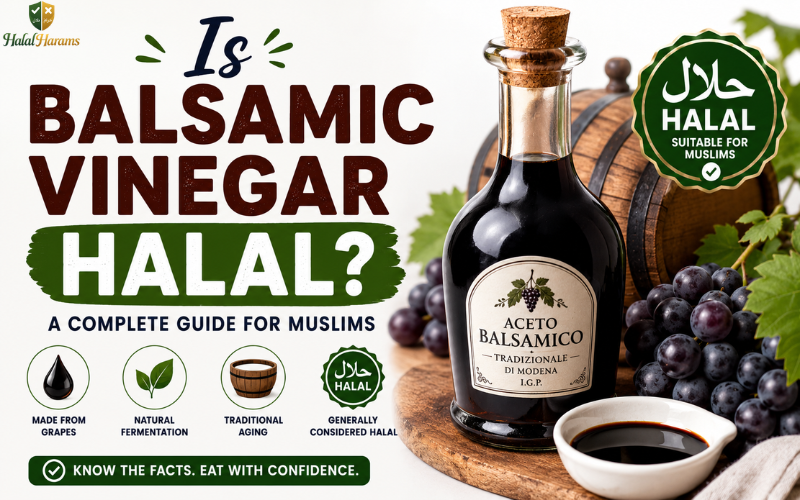
For Muslims, checking everyday ingredients can sometimes raise simple but important questions. One of them is “Is balsamic vinegar halal?” Balsamic vinegar is made mainly from grapes and is commonly used in salads, sauces, marinades, and other foods.
The answer is generally yes, balsamic vinegar can be halal, but Muslims should understand how it is made. Traditional balsamic vinegar starts with grape juice or grape must and goes through fermentation and aging. Some types also use wine vinegar during production. Islamic scholars have different views about vinegar made from wine, especially when the change from wine to vinegar is done intentionally.
For this reason, the type and production method can matter. A product with trusted halal certification is the easiest choice when there is doubt. Muslims should also check the label for added wine, alcohol, or other questionable ingredients.
So, balsamic vinegar is not automatically haram. Its halal status depends on its ingredients, production process, and the scholarly view being followed.
What Is Balsamic Vinegar?
Balsamic vinegar is a dark, flavorful vinegar traditionally produced in Italy. It is made from grape must, which is freshly crushed grape juice containing skins, seeds, and stems.
The grape must is:
- Cooked and concentrated
- Fermented naturally
- Aged in wooden barrels
- Developed into a thick, flavorful vinegar
Traditional balsamic vinegar can be aged for years, resulting in a rich taste and aroma.
Unlike ordinary vinegar, balsamic vinegar has:
- A sweeter flavor
- A thicker consistency
- A darker color
- A more complex taste profile
Today, balsamic vinegar is widely used in:
- Salad dressings
- Marinades
- Meat dishes
- Vegetables
- Gourmet recipes
Is Balsamic Vinegar Halal?
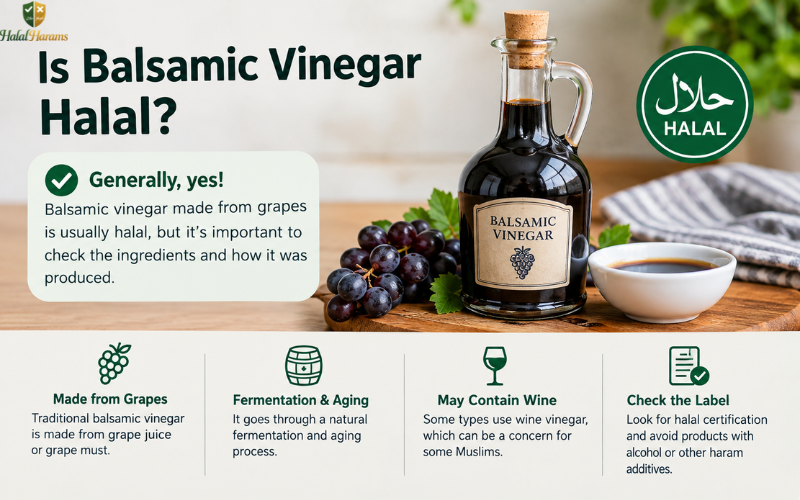
Yes, balsamic vinegar is generally considered halal by most Islamic scholars.
The primary reason is that the original fermented substance undergoes a complete transformation into vinegar. In Islamic jurisprudence, this transformation is known as Istihalah, meaning a complete change from one substance into another.
Once the alcohol has transformed into vinegar and no intoxicating properties remain, many scholars consider the final product halal.
However, Muslims should still verify ingredients and manufacturing processes, especially in commercial products.
Why Do Some Muslims Question Balsamic Vinegar?
The concern comes from the fact that balsamic vinegar begins with grapes and undergoes fermentation.
Some people associate fermentation with:
- Wine production
- Alcohol formation
- Intoxicating substances
Since alcohol is prohibited in Islam, some Muslims wonder whether balsamic vinegar still contains alcohol.
The answer depends on:
- The manufacturing process
- The final alcohol content
- Scholarly interpretation
Most scholars agree that properly produced vinegar is permissible.
Related Post: Is Kombucha Halal? Complete Guide For Muslims(2026)
How Is Balsamic Vinegar Made?
Understanding the production process helps explain why many scholars consider it halal.
The process typically involves:
- Harvesting grapes
- Crushing grapes into must
- Cooking the grape must
- Fermentation
- Aging in wooden barrels
- Conversion into vinegar
During fermentation, natural sugars may temporarily produce alcohol. However, as fermentation continues, bacteria convert alcohol into acetic acid, creating vinegar.
Stages of Balsamic Vinegar Production
| Stage | Purpose |
|---|---|
| Grape harvesting | Obtain raw ingredients |
| Crushing | Produce grape must |
| Cooking | Concentrate flavors |
| Fermentation | Begin transformation |
| Aging | Develop taste and texture |
| Vinegar formation | Create final product |
This transformation is central to the halal discussion.
The Islamic Principle of Istihalah
One of the strongest arguments supporting the permissibility of vinegar is the principle of Istihalah.
Istihalah refers to:
- Complete transformation
- Change in nature
- Change in characteristics
- Change in ruling
Examples often discussed by scholars include:
- Wine becoming vinegar
- Impure substances becoming pure through transformation
When the original intoxicating substance no longer exists in its previous form, many scholars consider the new substance permissible.
This principle plays a major role in the halal status of balsamic vinegar.
Does Balsamic Vinegar Contain Alcohol?
Many commercial balsamic vinegars contain extremely small trace amounts of naturally occurring alcohol.
However:
- The amount is usually very low
- It is not intoxicating
- It is a natural byproduct of fermentation
Most scholars distinguish between:
- Intoxicating alcoholic beverages
- Trace residual alcohol created naturally during food production
The overwhelming majority of balsamic vinegar products are not consumed for intoxication.
See Also: Is Dr Pepper Halal? A Complete Guide for Muslim(2026)
Scholarly Opinions on Balsamic Vinegar
Most contemporary scholars consider balsamic vinegar halal when:
- It has fully transformed into vinegar
- It is not intentionally consumed as alcohol
- No haram additives are included
Scholars generally agree that vinegar itself is permissible and has been accepted in Islamic tradition for centuries.
The key concern is whether complete conversion has occurred.
What About Vinegar Mentioned in Islamic Teachings?
Vinegar has a positive place in Islamic tradition.
Many scholars reference narrations indicating that vinegar is a lawful and beneficial food.
Because vinegar was commonly used during the early Islamic period, it has long been recognized as a permissible food item.
This contributes to the widespread scholarly acceptance of vinegar products.
Types of Balsamic Vinegar
Not all balsamic vinegar products are identical.
Common varieties include:
- Traditional balsamic vinegar
- Commercial balsamic vinegar
- Balsamic glaze
- Flavored balsamic vinegar
Common Types of Balsamic Vinegar
| Type | Typical Halal Status |
|---|---|
| Traditional balsamic vinegar | Usually halal |
| Commercial balsamic vinegar | Usually halal |
| Balsamic glaze | Check ingredients |
| Flavored balsamic vinegar | Verify additives |
Ingredient verification remains important.
Is Balsamic Glaze Halal?
Balsamic glaze is a thickened version of balsamic vinegar.
It often contains:
- Vinegar
- Sweeteners
- Flavorings
- Stabilizers
The vinegar itself may be halal, but additional ingredients should be reviewed.
Muslims should check:
- Flavoring sources
- Coloring agents
- Added preservatives
Halal certification can provide additional reassurance.
Flavored Balsamic Vinegar Concerns
Some flavored varieties contain:
- Fruit extracts
- Vanilla flavoring
- Artificial flavors
- Specialty ingredients
These products may require closer examination.
The concern is usually not the vinegar itself but the additional ingredients used in flavor enhancement.
Is Homemade Balsamic Vinegar Halal?
Homemade balsamic vinegar is generally halal when:
- Produced as vinegar
- Not intended for alcohol consumption
- Free from haram additives
The same principles applied to commercial products generally apply to homemade versions.
Halal Certification and Balsamic Vinegar
Many manufacturers seek halal certification to reassure Muslim consumers.
Certification helps verify:
- Ingredient compliance
- Production standards
- Manufacturing practices
- Contamination prevention
Table 3: Benefits of Halal Certification
| Benefit | Importance |
|---|---|
| Ingredient verification | High |
| Consumer confidence | High |
| Manufacturing review | High |
| Contamination control | High |
Certification is often helpful but not always required.
Can Balsamic Vinegar Become Haram?
Balsamic vinegar itself is generally halal.
However, products containing balsamic vinegar may become problematic if they include:
- Alcohol-based flavorings
- Non-halal additives
- Pork-derived ingredients
- Haram processing agents
Consumers should evaluate the complete ingredient list rather than focusing solely on the vinegar.
Common Foods Containing Balsamic Vinegar
Balsamic vinegar appears in many foods including:
- Salad dressings
- Marinades
- Meat sauces
- Sandwich toppings
- Roasted vegetables
- Gourmet appetizers
The halal status of these foods depends on all ingredients involved.
Nutritional Benefits of Balsamic Vinegar
Balsamic vinegar is often used in small quantities but contains beneficial compounds.
Potential benefits include:
- Low calorie content
- Natural antioxidants
- Flavor enhancement without excessive fat
- Reduced need for heavy sauces
Nutritional Characteristics of Balsamic Vinegar
| Characteristic | Benefit |
|---|---|
| Low calories | Supports balanced diets |
| Rich flavor | Enhances meals |
| Antioxidants | Supports overall wellness |
| Low fat | Useful in healthy cooking |
It can be a flavorful addition to many meals.
Common Misconceptions About Balsamic Vinegar
“All Fermented Foods Are Haram”
Fermentation alone does not make a product haram.
Many halal foods undergo fermentation during production.
“Balsamic Vinegar Is the Same as Wine”
Balsamic vinegar is a distinct product that undergoes transformation into vinegar.
“Any Trace Alcohol Makes Food Haram”
Scholars often distinguish between intoxicating beverages and tiny naturally occurring residues that do not intoxicate.
“All Vinegar Products Are Automatically Halal”
Additional ingredients may affect halal status.
How to Verify Halal Balsamic Vinegar
To ensure balsamic vinegar is halal:
- Read ingredient labels carefully
- Check for halal certification
- Avoid questionable additives
- Research trusted manufacturers
- Verify flavored products separately
Quick Halal Verification Checklist
| Question | Action |
|---|---|
| Is it pure balsamic vinegar? | Usually halal |
| Are flavorings added? | Review ingredients |
| Halal certification available? | Verify label |
| Any alcohol-based additives? | Check carefully |
| Trusted manufacturer? | Prefer reputable brands |
These steps help reduce uncertainty.
Why Understanding Balsamic Vinegar Matters
Balsamic vinegar is increasingly used in modern cooking, restaurant meals, and packaged foods. Because it is produced through fermentation, questions about its halal status are common among Muslim consumers.
Understanding:
- Vinegar production
- Islamic rulings
- Istihalah
- Ingredient verification
helps Muslims make informed dietary decisions and avoid unnecessary confusion.
See Also: Is Root Beer Halal? Complete Guide for Muslims(2026)
Frequently Asked Questions
Is balsamic vinegar halal
Yes, most balsamic vinegar is considered halal because it has transformed into vinegar and is no longer intoxicating.
Does balsamic vinegar contain alcohol
Some products may contain tiny trace amounts from fermentation, but they are generally not intoxicating.
Is balsamic glaze halal
Usually yes, but additional ingredients should be checked carefully.
Can Muslims eat foods made with balsamic vinegar
Yes, provided the overall food contains no haram ingredients.
Is traditional balsamic vinegar halal
Most scholars consider traditional balsamic vinegar halal after complete conversion into vinegar.
Should I look for halal certification
Certification can provide additional confidence, especially for flavored or processed products.
Final Remarks
Balsamic vinegar is generally halal, but its status can depend on how it is made. Vinegar made from grapes or grape must is commonly considered permissible. However, some balsamic products may use wine vinegar or alcohol during production, which can raise questions for Muslims.
Because scholars may differ on vinegar made from wine, the safest choice is to check the ingredients and halal certification when available. This is especially useful for traditional or imported balsamic vinegar.
In simple terms, Muslims should not judge balsamic vinegar by its name alone. Check the source, ingredients, and production method. If the product has clear halal certification, it is an easier choice.
