
Sugar alcohol is generally halal, and Muslims can usually consume foods containing it without worry. However, the answer to “Is sugar alcohol halal?” depends on the specific ingredient, its source, and whether the finished product contains any prohibited substances. Sugar alcohols such as erythritol, xylitol, sorbitol, and maltitol are commonly found in sugar-free chewing gum, candies, chocolates, protein bars, and low-carb foods. Their name can confuse Muslims because Islam prohibits intoxicants, including intoxicating alcoholic drinks.
The important distinction is that sugar alcohols are a different group of chemical compounds and do not have the intoxicating effects of ethanol. This means they are not automatically haram simply because they contain the word alcohol. Understanding how these sweeteners are made and what else is present in a product can help you make informed halal food choices without avoiding permissible ingredients unnecessarily.
Is Sugar Alcohol Halal or Haram?
Sugar alcohols are generally halal when they are non-intoxicating, derived from permissible sources, and free from prohibited ingredients or contamination.
The ruling applies to common food-grade sugar alcohols, including erythritol, xylitol, sorbitol, mannitol, and maltitol. These sweeteners are widely used to replace some or all of the sugar in processed foods.
| Sugar alcohol | Common food uses | General halal ruling |
|---|---|---|
| Erythritol | Sugar-free drinks and sweets | Generally halal |
| Xylitol | Chewing gum and mints | Generally halal |
| Sorbitol | Candy and baked goods | Generally halal |
| Maltitol | Sugar-free chocolate | Generally halal |
| Mannitol | Sweets and confectionery | Generally halal |
| Isomalt | Hard candies | Generally halal |
| Lactitol | Sugar-free desserts | Generally halal |
These are general rulings on the ingredients themselves, not a guarantee that every product containing them is halal. Other ingredients and the manufacturing process may need to be checked separately.
What Is Sugar Alcohol, and Why Is It Called Alcohol?
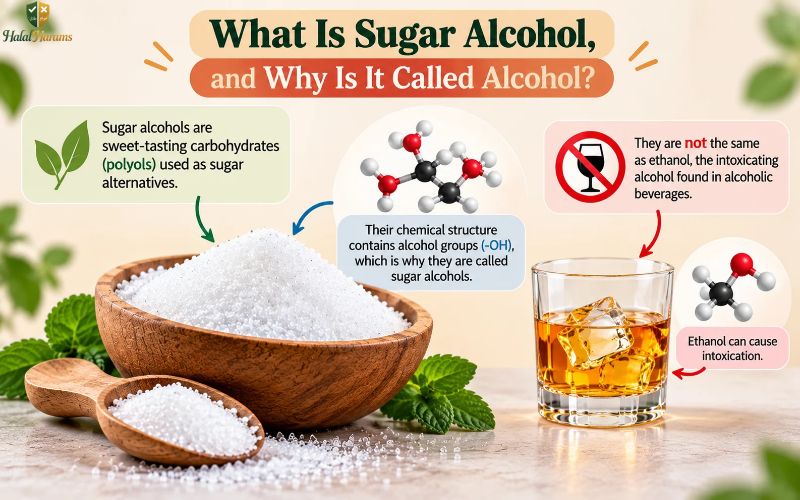
Sugar alcohols, also known as polyols, are sweet-tasting carbohydrates used as alternatives to ordinary sugar. Some occur naturally in small amounts in fruits and vegetables, while others are manufactured by processing sugars or starches.
The word alcohol refers to their chemical structure. It does not mean that these sweeteners are equivalent to ethanol, the intoxicating substance associated with alcoholic beverages.
| Substance | Main characteristic | Islamic consideration |
|---|---|---|
| Ethanol in intoxicating beverages | Can cause intoxication | Intoxicating beverages are prohibited |
| Erythritol | Non-intoxicating sweetener | Generally permissible |
| Xylitol | Non-intoxicating sweetener | Generally permissible |
| Sorbitol | Non-intoxicating sweetener | Generally permissible |
A Muslim should not declare an ingredient haram based on its scientific name alone. Its actual properties, source, and use must be considered.
Related Post: Is Rice Wine Halal or Haram? Complete Guide(2026)
What Does Islam Say About Sugar Alcohol?
Islam prohibits intoxicants, but the ruling must be applied to the substance in question rather than to a word that appears in its name.
Allah says in the Quran:
“O you who have believed, indeed, intoxicants, gambling, [sacrificing on] stone alters to other than Allah, and divining arrows are but defilement from the work of Satan, so avoid it that you may be successful.”
— Quran 5:90, Sahih International translation
This verse establishes the prohibition of intoxicants. Ordinary sugar alcohols, such as xylitol and erythritol, do not have the intoxicating properties of alcoholic beverages.
The Prophet Muhammad ﷺ also taught that intoxicating substances are prohibited. The relevant question, therefore, is whether a particular ingredient is an intoxicant or falls under another prohibition. A chemical name alone is not enough to establish that ruling.
Are Sugar Alcohols Halal According to All Four Madhabs?
The Hanafi, Maliki, Shafi’i, and Hanbali schools all recognize the prohibition of intoxicants. However, detailed rulings concerning alcohol-related substances can differ depending on their source, nature, and use.
There is no sound basis for claiming that one of the four schools automatically prohibits every modern sweetener called a sugar alcohol. These ingredients need to be assessed according to their actual characteristics.
| Madhab | Relevant Islamic principle | Practical application |
|---|---|---|
| Hanafi | Prohibition of intoxicants, with detailed distinctions between substances | Assess the actual ingredient and its properties |
| Maliki | Prohibition of intoxicants and consideration of relevant legal characteristics | Do not judge a sweetener by its name alone |
| Shafi’i | Prohibition of intoxicating substances | Ordinary non-intoxicating polyols are generally permissible |
| Hanbali | Prohibition of intoxicants and relevant prohibited substances | Check the ingredient’s source when a genuine concern exists |
For everyday products containing pure erythritol or xylitol, there is generally no reason to assume they are haram simply because of the term sugar alcohol. A specific product may require additional investigation if its ingredients or manufacturing process raise a legitimate concern.
How Are Sugar Alcohols Made?
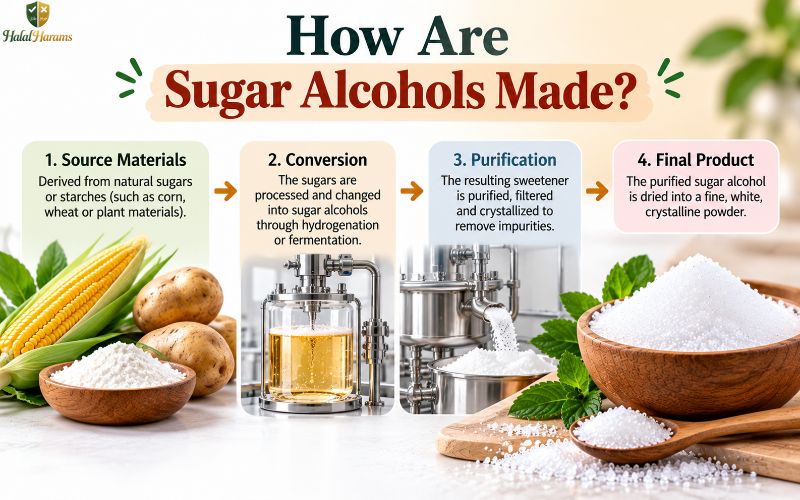
Sugar alcohols can be produced through different processes. Some are obtained from plant materials, while others are manufactured by processing glucose or other sugars.
For example, erythritol is commonly produced by fermenting glucose. Sorbitol is often made by processing glucose, while xylitol can be produced from plant-derived materials. Maltitol is manufactured from maltose obtained from starch.
| Ingredient | Common production method | What Muslims should know |
|---|---|---|
| Erythritol | Fermentation of glucose | Generally halal when properly produced |
| Xylitol | Processing suitable plant-derived sugars | Generally halal |
| Sorbitol | Processing glucose | Generally halal |
| Maltitol | Processing maltose from starch | Generally halal |
| Mannitol | Industrial processing or extraction | Generally halal |
Fermentation does not automatically make an ingredient haram. The relevant questions include what substance is produced, whether it is intoxicating, and whether prohibited materials are involved in a way that affects the ruling.
A plant-derived ingredient is not automatically halal in every circumstance, just as an industrially manufactured ingredient is not automatically haram. The details matter.
Related Post: Are Oysters Halal? Complete Islamic Rulings(2026)
When Can a Product Containing Sugar Alcohol Be Haram?
The sweetener itself may be permissible even when the complete product contains another ingredient that requires investigation.
For example, a sugar-free chocolate bar may contain maltitol, but its other ingredients could include gelatine of uncertain origin or flavourings that need verification.
Consider these common situations:
- Prohibited ingredients: A sweetener may be halal while another ingredient in the same product is not.
- Questionable flavourings: Certain flavour preparations may require further information about their composition or production.
- Contamination: If a product becomes contaminated with a prohibited substance, the circumstances must be assessed according to Islamic principles.
- Unclear certification: A sugar-free label describes the product’s sugar content; it does not establish halal status.
These possibilities should not lead Muslims to treat every sugar-free product with suspicion. They simply mean that the complete ingredient list matters when there is a genuine reason to investigate.
Are Sugar-Free Candies and Chewing Gum with Sugar Alcohol Halal?
Sugar-free candies and chewing gum containing erythritol, sorbitol, or xylitol are generally permissible, provided their other ingredients are halal.
The same applies to sugar-free chocolate, protein bars, low-carb desserts, and similar foods. The presence of a sugar alcohol is not, by itself, a reason to reject the product.
| Product | Ingredient to check | Practical advice |
|---|---|---|
| Sugar-free chewing gum | Xylitol or sorbitol, plus flavourings | Generally acceptable if other ingredients are permissible |
| Sugar-free chocolate | Maltitol or erythritol, plus emulsifiers | Check any gelatine or questionable additives |
| Protein bars | Erythritol or other polyols | Check flavourings and other ingredients |
| Sugar-free candy | Isomalt or maltitol | Review the complete ingredient list |
| Low-carb desserts | Various sugar alcohols | Check all ingredients, especially those of uncertain origin |
For instance, if chewing gum contains xylitol, gum base, and permissible flavourings, the xylitol itself is not a reason to consider it haram. If the product contains an ingredient of uncertain origin, investigate that ingredient separately.
Related Post: Is Tyson Chicken Halal? Can Muslims Eat It(2026)
Does Fermentation Make Sugar Alcohol Haram?
No. Fermentation is a manufacturing process, and its use does not automatically make the resulting ingredient prohibited.
Erythritol is commonly produced through microbial fermentation of glucose. The resulting sweetener is a non-intoxicating substance with a different chemical identity and purpose from ethanol in alcoholic drinks.
Islamic rulings cannot be based on the word fermentation alone. The starting materials, resulting substance, and manufacturing details may all be relevant when a genuine concern exists.
This distinction is especially useful when reading ingredient labels. A manufacturer may use fermentation to produce an ordinary food ingredient without producing an intoxicating beverage.
How Can Muslims Check Whether Sugar Alcohol Is Halal?
Use these practical steps when buying sugar-free foods:
- Identify the sweetener. Check whether the ingredient is erythritol, xylitol, sorbitol, maltitol, or another polyol.
- Read the full ingredient list. Do not rely only on claims such as “sugar-free” or “natural.”
- Check questionable ingredients separately. Gelatine, certain flavourings, and other ingredients of uncertain origin may need further investigation.
- Look for reliable halal certification. This can be particularly helpful for products with many ingredients or complex manufacturing processes.
- Ask when necessary. If the source of a specific ingredient remains unclear, contact the manufacturer or consult a qualified Islamic scholar.
You do not need to investigate every ordinary ingredient without reason. The aim is to make a sound decision based on useful information rather than unnecessary doubt.
Related Post: Is Whey Halal? A Muslim’s Guide to Whey Protein
Frequently Asked Questions
Is sugar alcohol halal in Islam?
Yes, ordinary non-intoxicating sugar alcohols are generally halal when derived from permissible sources and used in products without prohibited ingredients.
Is erythritol halal or haram?
Erythritol is generally halal. It is commonly produced through glucose fermentation and does not have the intoxicating properties of ethanol.
Is xylitol halal for Muslims?
Xylitol is generally halal because it is a non-intoxicating sweetener. Muslims should also check the other ingredients in the product containing it.
Is sorbitol halal in candy?
Sorbitol is generally halal. However, the complete candy should be checked for other ingredients that may be prohibited or of uncertain origin.
Does the word alcohol mean an ingredient is haram?
No. The word alone does not determine the Islamic ruling. Sugar alcohols are chemically different from intoxicating ethanol and must be assessed accordingly.
Are all sugar-free products halal?
No. Sugar-free products can contain ingredients that require further investigation. Check the complete ingredient list and seek reliable halal certification when needed.
Final Verdict
Sugar alcohol is generally halal, and Muslims do not need to avoid ordinary food-grade sweeteners such as erythritol, xylitol, sorbitol, and maltitol simply because of their name. These substances are non-intoxicating and are commonly used in food manufacturing.
The sensible approach is to distinguish sugar alcohols from intoxicating alcohol and assess the complete product when necessary. If a particular ingredient has a questionable source or the manufacturing process raises a genuine concern, seek reliable clarification before making a decision.
Disclaimer: This article offers general Islamic guidance, not a binding fatwa. Consult a qualified local scholar or imam for a ruling on a specific product or disputed ingredient.

1 comment