
Is lamb halal in Islam? Yes, lamb is halal, and Muslims can eat it when the animal is slaughtered according to Islamic requirements. Lamb is the meat of a young sheep, while mutton generally comes from an older sheep. Both are permissible to eat under Islamic dietary laws, provided the meat is obtained and prepared in a halal manner.
However, there is an important distinction between an animal that is halal by nature and meat that is halal to consume. Even though sheep are permissible animals, questions can arise about slaughter methods, meat sold in supermarkets, non-Muslim slaughterers, and cross-contamination during cooking. Understanding these details helps Muslims make informed food choices without unnecessary doubt. The Quran establishes broad principles for lawful and unlawful food, while the Sunnah explains important aspects of slaughter and consumption. This article explores the Islamic ruling on lamb, the conditions that make it halal, differences among scholarly opinions, and practical guidance for buying and eating lamb today.
Is Lamb Halal or Haram?
Lamb is permissible in Islam because sheep are lawful animals. The meat must also meet the applicable Islamic slaughter requirements and must not be contaminated with prohibited substances.
The ruling is straightforward: lamb is halal when it comes from a permissible animal and is slaughtered in an Islamically acceptable way. The same general ruling applies to mutton and other sheep meat.
| Situation | Islamic ruling |
|---|---|
| Lamb slaughtered according to halal requirements | Halal |
| Mutton from a properly slaughtered sheep | Halal |
| Sheep that died naturally before slaughter | Haram to eat |
| Sheep killed by strangulation or a fatal blow | Haram, unless a valid exception applies before death |
| Halal lamb cooked with pork or contaminated with it | Not permissible if the meat is contaminated |
| Lamb with uncertain slaughter status | Requires further investigation according to the circumstances |
The animal’s age does not make lamb haram. Its species, condition at slaughter, method of slaughter, and handling are the relevant considerations.
Why Is Lamb Halal in Islam?
Sheep are among the animals Muslims are permitted to eat. The Quran describes livestock as a blessing and permits people to benefit from lawful animals.
Allah says in the Quran:
“And the grazing livestock He has created for you; in them is warmth and benefits, and from them you eat.” — Surah An-Nahl 16:5
This verse establishes the benefits of livestock, including their use as food. The permissibility of sheep is also reflected in Islamic teachings about sacrifice, including the sacrifice of sheep during Eid al-Adha.
Surah Al-Ma’idah, verse 3, identifies prohibited categories of meat, including carrion, blood, and animals slaughtered in certain forbidden ways. Sheep are not prohibited by species, so their meat is lawful when the relevant conditions are fulfilled.
In practical terms, Muslims do not need to avoid lamb itself. They need to establish that the meat they consume meets Islamic dietary requirements.
Related Post: Is Sugar Alcohol Halal? Complete Guide For Muslims
What Makes Lamb Halal to Eat?
The permissibility of lamb depends on more than the animal being a sheep. Islamic law sets conditions for slaughter and prohibits eating animals that die in certain unlawful ways.
The animal must be alive at slaughter
The sheep must be alive when slaughter begins. If it has already died from illness, an accident, strangulation, or another cause before the required slaughter, its meat is not permissible.
An animal that is sick or injured is not automatically haram. Its condition and whether it remains alive at the time of valid slaughter matter.
The slaughter must meet Islamic requirements
The prescribed slaughter must sever the required throat passages and blood vessels according to the applicable school of Islamic law. The slaughterer must use an appropriate sharp instrument and avoid unnecessary suffering.
Allah’s name should be mentioned
Muslims are instructed to mention Allah’s name over the animal at slaughter. Scholars differ over the ruling when the slaughterer deliberately omits the tasmiyah (saying Bismillah), while forgetfulness is treated differently by many scholars.
The slaughterer must be eligible
A Muslim can perform halal slaughter. The Quran also discusses food slaughtered by the People of the Book, meaning Jews and Christians, in Surah Al-Ma’idah 5:5. This permission has important conditions and scholarly interpretations, particularly regarding modern slaughter practices.
What Does the Quran Say About Lamb and Halal Meat?
The Quran does not name lamb as a prohibited food. Instead, it provides general principles that help Muslims distinguish lawful meat from unlawful meat.
| Quranic reference | Main teaching | Relevance to lamb |
|---|---|---|
| Surah Al-Ma’idah 5:1 | Fulfil lawful obligations and observe Allah’s commands | Supports following Islamic dietary rules |
| Surah Al-Ma’idah 5:3 | Prohibits carrion, blood, and certain improperly killed animals | Explains why slaughter conditions matter |
| Surah Al-Ma’idah 5:5 | Permits certain foods of the People of the Book | Relevant to qualifying Jewish or Christian slaughter |
| Surah Al-An’am 6:121 | Warns against eating what has not had Allah’s name mentioned over it, in its context | Relevant to discussions about tasmiyah and slaughter |
These verses should be read in their proper context rather than treated as isolated phrases. Scholars use the Quran alongside authentic Hadith and established principles of Islamic jurisprudence to determine the ruling in specific circumstances.
The central lesson is clear: sheep are lawful animals, but not every piece of meat from a sheep is automatically lawful to eat.
Related Post: Are Oysters Halal? Complete Islamic Rulings(2026)
Is Lamb Halal in All Four Madhabs?
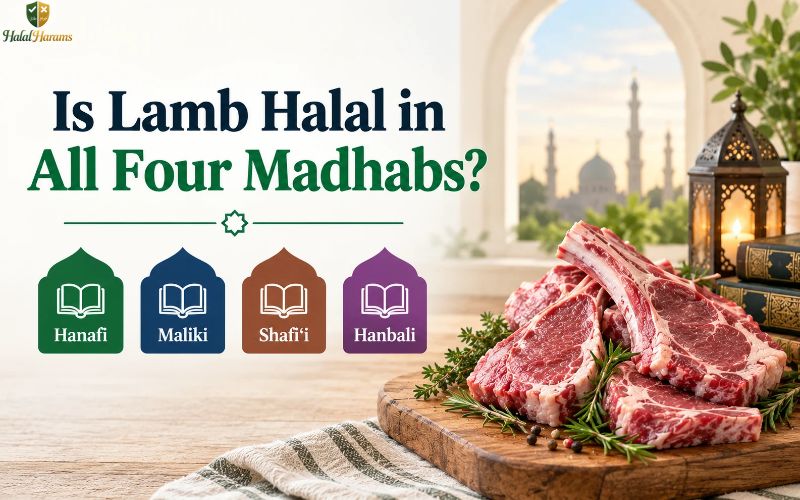
The Hanafi, Maliki, Shafi’i, and Hanbali schools all recognize sheep as a permissible animal. There are, however, differences in certain details of slaughter, including the consequences of omitting Allah’s name and the requirements for a valid slaughter.
| Madhab | General ruling on sheep meat | Important consideration |
|---|---|---|
| Hanafi | Halal when validly slaughtered | Deliberately omitting Bismillah is generally treated seriously and affects permissibility |
| Maliki | Halal when validly slaughtered | The intention and required conditions of slaughter matter |
| Shafi’i | Halal when validly slaughtered | Forgetting the tasmiyah does not invalidate slaughter; the details of deliberate omission differ from other schools |
| Hanbali | Halal when validly slaughtered | Tasmiyah is treated as an important slaughter condition, with details discussed by scholars |
These summaries are not a substitute for a detailed fatwa. Each school has further rules concerning the slaughterer’s eligibility, the animal’s condition, and how mistakes are treated.
For ordinary consumers, the practical point is that properly slaughtered lamb is halal across the four major Sunni schools. Differences generally arise when a specific slaughter condition is missing or disputed.
Is Supermarket Lamb Halal?
Lamb sold in a supermarket is not automatically halal or haram. Its status depends on the source, slaughter method, and reliable information available about how it was produced.
A supermarket may sell certified halal lamb, lamb from a supplier whose practices are known, and ordinary lamb without halal certification. These products should not be assumed to have the same status.
| Type of lamb sold | What should you do? |
|---|---|
| Clearly labelled halal with reliable certification | Check the certification if necessary and purchase with reasonable confidence |
| From a trusted halal butcher | Follow the reliable information you have about the butcher’s supplier and practices |
| Imported lamb with no halal label | Check the country of origin, supplier, and slaughter information |
| Ordinary supermarket lamb with unknown slaughter details | Ask the retailer or supplier before assuming it is halal |
| Lamb from a source known to use prohibited slaughter methods | Avoid it |
Certification is a practical way to verify sourcing and slaughter, especially when buying packaged meat. A label alone is not an absolute guarantee in every situation, so credible certification and trustworthy supply chains matter.
Where information is genuinely unavailable, rulings can depend on the source and circumstances. A person should not declare all supermarket lamb haram simply because it lacks a label, nor assume every product is halal without considering relevant evidence.
Related Post: Is Nando’s Halal? What Muslims Should Know Before Ordering
Is Lamb Halal if It Is Not Zabiha?
The term zabiha commonly refers to meat slaughtered according to Islamic requirements. If lamb has not been slaughtered in a manner recognized as valid under the relevant Islamic ruling, it is not permissible simply because the animal itself is halal.
The ruling can be more nuanced when the slaughterer is Jewish or Christian. Surah Al-Ma’idah 5:5 recognizes the food of the People of the Book as lawful, and classical scholars discuss the scope and conditions of this permission.
Modern commercial slaughter creates additional questions. For example, a sheep might be killed by a method that causes death before the required throat cut, or it might be slaughtered without the required invocation under the applicable ruling. Such circumstances require careful assessment.
If you follow a particular madhab or halal certification standard, use its guidance when checking unfamiliar meat. Do not assume that every non-Muslim slaughter method is acceptable or that every non-Muslim slaughterer automatically makes meat forbidden.
Is Lamb Halal if It Is Machine-Slaughtered?
Machine-slaughtered lamb can be halal under certain scholarly and certification standards, but the ruling depends on how the process is conducted.
Questions include whether the animal is alive when slaughtered, whether the required cuts are made, whether Allah’s name is mentioned as required, and whether the equipment and supervision meet the relevant standard.
Some scholars and halal certification bodies accept qualifying forms of machine slaughter, while others apply stricter conditions or do not accept particular systems.
| Slaughter situation | Practical guidance |
|---|---|
| Manual slaughter by a qualified slaughterer | Generally accepted when all requirements are met |
| Machine slaughter under a recognized halal standard | May be accepted if that standard’s conditions are fulfilled |
| Machine process with uncertain animal deaths before the cut | Requires investigation |
| Process that fails the applicable slaughter requirements | Not halal under that ruling |
For consumers, the safest practical approach is to check whether the supplier’s machine-slaughter process has been assessed by a certification body whose standards you trust.
Related Post: Is Beef Halal? A Complete Guide for Muslims
Can Muslims Eat Rare or Undercooked Lamb?
Yes. Lamb does not become haram merely because it is served pink or cooked to a particular level. Islamic dietary law does not prescribe a universal doneness temperature for lamb.
However, food safety is a separate issue from halal status. Raw or undercooked meat can contain harmful microorganisms, and cooking recommendations depend on the cut, preparation method, and food-safety guidance.
Muslims should also make sure the meat has not been cooked using prohibited ingredients, such as pork-derived products, or prepared with equipment contaminated by them.
| Preparation method | Halal status |
|---|---|
| Roasted lamb with permissible herbs and spices | Halal |
| Lamb curry made with permissible ingredients | Halal |
| Lamb cooked with wine or another prohibited ingredient | Not permissible when the preparation involves a prohibited substance |
| Lamb cooked on a grill contaminated with pork residue | Avoid unless the contamination has been properly removed |
| Pink lamb cooked without prohibited ingredients | Halal in principle |
Choose safe cooking practices even when the meat is halal. Religious permissibility and protection from foodborne illness are related practical concerns, but they are not the same ruling.
Is Lamb Halal During Pregnancy or for Children?
Lamb is halal for pregnant women, children, and adults, provided the usual Islamic dietary requirements are met. There is no general Islamic prohibition against these groups eating lamb.
The separate concern is food safety. Pregnant women, young children, older adults, and people with weakened immune systems can face greater risks from foodborne illness. They should follow appropriate medical and food-safety advice about cooking meat thoroughly and preventing cross-contamination.
Lamb can also form part of a balanced diet because it provides protein, iron, vitamin B12, and other nutrients. The amount and frequency that suit an individual depend on their overall diet and health needs.
From an Islamic perspective, the key question remains whether the meat is lawfully sourced and prepared. Health considerations may influence how it should be cooked or how much someone should eat, but they do not change sheep’s general halal status.
Related Post: What Is Halal Food? Complete Guide For Muslims(2026)
Common Misconceptions About Lamb Being Halal
Several misunderstandings can cause unnecessary confusion about eating lamb. These are the points worth remembering.
- “All lamb is halal because sheep are halal.” Not necessarily. The animal is permissible, but its death and slaughter circumstances matter.
- “Lamb from a non-Muslim country is always haram.” This is too broad. The Quran permits qualifying food of the People of the Book, subject to relevant conditions and scholarly interpretation.
- “Lamb must be cooked thoroughly to become halal.” Cooking does not determine the slaughter’s religious validity, although proper cooking is important for food safety.
- “Mutton and lamb have different halal rulings.” Both come from sheep, so the same general dietary principles apply.
- “Halal certification is the only possible evidence of halal status.” Certification is useful, but trustworthy knowledge of the source and slaughter can also be relevant.
Understanding these distinctions helps Muslims avoid both careless assumptions and unnecessary hardship.
Frequently Asked Questions
Is lamb halal in Islam?
Yes. Lamb is halal because sheep are permissible animals. The meat must satisfy the applicable Islamic slaughter requirements and remain free from prohibited contamination.
Is lamb halal without Bismillah?
The ruling depends on whether Bismillah was deliberately omitted or forgotten and which scholarly position is followed. Deliberate omission is treated strictly by many scholars.
Is lamb halal in the USA?
Lamb in the USA can be halal, but the country of sale does not establish its status. Check the supplier, slaughter method, and credible halal certification.
Is lamb halal if it is not slaughtered by a Muslim?
It may be permissible when slaughtered by an eligible person from the People of the Book and the applicable Islamic conditions are met. The specific method and circumstances matter.
Is mutton halal like lamb?
Yes. Mutton is meat from sheep, usually older sheep, and is halal under the same general rules that apply to lamb.
Can Muslims eat lamb from a regular grocery store?
Yes, if the meat is established to be halal. Check its source and slaughter information rather than assuming that every grocery-store product is permissible.
Related Post: Is Wingstop Halal? Complete Guide for Muslims(2026)
Practical Takeaway
Before buying or eating lamb, follow these simple steps:
- Identify the source. Look for a reliable halal butcher, supplier, or certification.
- Check slaughter information. Confirm that the meat was produced according to a standard you accept.
- Ask when uncertain. Contact the seller about the slaughter method rather than relying only on the product’s name or appearance.
- Check preparation. Make sure the lamb has not been mixed with pork or prepared using prohibited ingredients.
- Follow reliable religious guidance. If a specific issue concerns your madhab or the circumstances of slaughter, seek a qualified scholar’s ruling.
Final ruling on “Is Lamb Halal?”: Lamb is halal in Islam when it comes from a permissible sheep and meets the relevant Islamic slaughter requirements. Mutton follows the same general ruling. The main concern is not whether sheep meat is halal by nature, but whether the particular meat was slaughtered and handled permissibly.
Disclaimer: This article provides general Islamic information, not an individual fatwa. Consult a qualified local scholar or imam for guidance on a specific slaughter method, supplier, or disputed case.
