
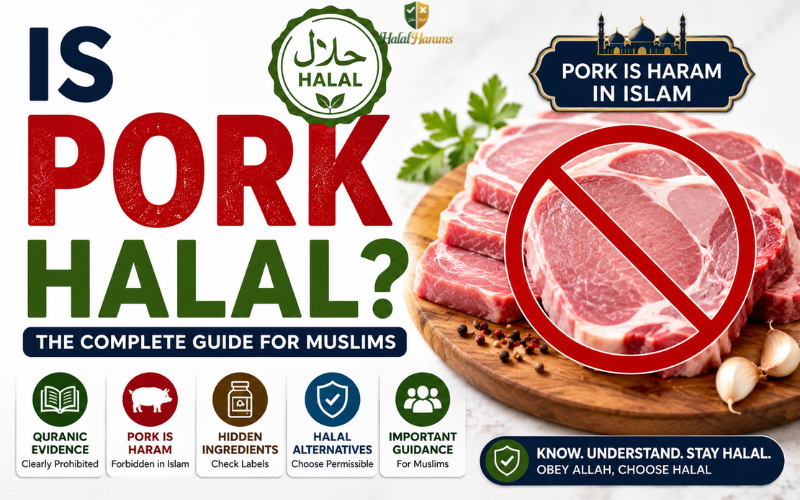
If you are asking “Is pork halal?”, the answer is clear: No, pork is haram (forbidden) in Islam. The Quran explicitly prohibits the flesh of swine, and this ruling is accepted by the recognized Sunni schools of Islamic jurisprudence. The prohibition is not limited to bacon or a particular cut of meat; Muslims are required to avoid pork and products that contain identifiable pork-derived ingredients.
At the same time, Islamic law recognizes genuine situations of necessity, where a person may have no lawful food available. Understanding this exception, as well as hidden pork ingredients such as pork gelatin and lard, is important for Muslims living in places where pork products are common.
This article explains the ruling from the Quran, Sunnah, and basic principles of halal and haram food in practical terms.
Is Pork Halal or Haram?
Pork is haram (forbidden) in Islam. There is no recognized disagreement among the major Sunni schools about eating pork.
The Quran directly mentions the flesh of swine among foods Allah has forbidden. This appears in several places, including Surah Al-Baqarah 2:173, Surah Al-Ma’idah 5:3, Surah Al-An’am 6:145, and Surah An-Nahl 16:115.
| Question | Islamic ruling |
|---|---|
| Is pork halal? | No, it is haram |
| Can Muslims eat bacon made from pork? | No |
| Is pork sausage halal? | No |
| Is lard halal? | No, when it is pork fat |
| Is pork gelatin automatically halal? | Generally avoided; scholarly discussion exists |
| Is pork allowed during genuine starvation? | A limited necessity exception may apply |
The basic rule is straightforward: a Muslim should not knowingly eat pork or ordinary pork-derived food ingredients.
What Does the Quran Say About Pork?
The clearest evidence comes from the Quran itself. Allah says in Surah Al-Baqarah 2:173 that He has forbidden carrion, blood, the flesh of swine, and animals dedicated to other than Allah. The same verse also describes the limited exception for someone compelled by genuine necessity.
Surah Al-An’am 6:145 also specifically describes swine as rijs, commonly translated as impure or filthy.
This means the prohibition does not depend on modern nutritional research. A Muslim follows the ruling because Allah has prohibited it.
Is There a Hadith About Pork Being Haram?
Yes. The Sunnah also supports the prohibition.
Sahih Muslim records a report in which the Prophet Muhammad ﷺ stated that Allah and His Messenger prohibited the sale of wine, carcasses, swine, and idols. This shows that the issue was not simply about whether someone personally liked or disliked eating pork; swine was treated as prohibited in Islamic law.
| Islamic source | What it establishes |
|---|---|
| Quran 2:173 | Swine is forbidden as food |
| Quran 5:3 | Swine is included among prohibited foods |
| Quran 6:145 | Swine is described as rijs |
| Quran 16:115 | The same prohibition and necessity exception |
| Sahih Muslim | Prohibition concerning swine also appears in the Sunnah |
So, the ruling is supported by both Quran and Sunnah, rather than being based on a later cultural practice.
Related Post: Is Beef Gelatin Halal? Complete Guide for Muslims (2026)
Does Pork Remain Haram If It Is Cooked?
Yes, cooking does not make pork halal.
Roasting, frying, boiling, smoking, grilling, or adding spices does not change the basic Islamic ruling on pork meat. If the ingredient remains pork, changing the cooking method does not make it permissible.
For example, pork bacon does not become halal because it is fried, and pork sausage does not become halal because it is mixed with beef or chicken.
The same principle applies to a product that contains recognizable pork fat or lard. The presence of a halal ingredient alongside a haram ingredient does not automatically make the finished food halal.
Is Pork Haram in All Four Madhabs?
The four well-known Sunni schools—Hanafi, Maliki, Shafi’i, and Hanbali—agree that eating pork is prohibited.
There can be differences between madhabs regarding some purity and contact questions involving pigs, but these should not be confused with the basic ruling on eating pork.
| Madhab | Eating pork | General position |
|---|---|---|
| Hanafi | Haram | Pork cannot be eaten |
| Maliki | Haram | Pork cannot be eaten |
| Shafi’i | Haram | Pork cannot be eaten |
| Hanbali | Haram | Pork cannot be eaten |
One interesting fiqh distinction concerns the physical purity of living pigs. The Maliki school has a different position concerning the purity of living animals, while schools such as the Shafi’i school treat pigs as impure.
That difference does not mean that Malikis consider pork halal to eat. The prohibition of consuming pork remains.
Why Is Pork Haram in Islam?
The primary answer is simple: Allah prohibited it.
Muslims do not need to discover a medical explanation before accepting a clear command from Allah. There may be wisdoms behind Islamic dietary laws, but the legal ruling comes from revelation.
The Quran itself gives the prohibition, while also describing swine as rijs in Surah Al-An’am.
Claims about particular diseases, parasites, or health risks should therefore not be presented as the reason that makes pork haram. Even if scientific findings change over time, the Quranic ruling remains.
Can Muslims Eat Food That Contains Pork Ingredients?
Generally, no. If a food clearly contains pork meat, pork fat, lard, or another pork-derived substance that remains present in the product, a Muslim should avoid it.
This is where modern packaged food can become complicated. Pork may not always appear simply as the word “pork.”
| Ingredient or product | Typical concern |
|---|---|
| Pork meat | Haram |
| Bacon from pork | Haram |
| Ham from pork | Haram |
| Pork sausage | Haram |
| Lard | Pork fat; haram |
| Pork gelatin | Generally avoided; scholarly discussion exists |
| Pork-derived enzymes | Source and manufacturing process should be checked |
| Vegetable gelatin alternatives | Generally permissible if otherwise halal |
For processed foods, reading the ingredient label is one of the easiest practical steps a Muslim can take.
Is Pork Gelatin Haram?
Pork-derived gelatin requires more detail.
Gelatin can be produced from animal skin, bones, and connective tissues. If the source is a pig, many contemporary scholars consider the resulting gelatin impermissible, particularly when the original substance has not undergone a complete legally recognized transformation.
There is, however, a genuine fiqh discussion about istihalah, meaning substantial transformation of one substance into another.
Some scholars consider a complete transformation capable of changing the ruling, while others do not consider ordinary commercial gelatin processing sufficient transformation.
For everyday food choices, a practical approach is to choose halal-certified, bovine, or plant-based gelatin when available.
What About Lard and Pork Fat?
Lard is fat obtained from pigs. It is not made halal simply because it is separated from the meat.
Therefore, products containing ordinary pork lard should be avoided.
This matters because lard can appear in foods such as baked goods, pastries, fried products, and some processed foods. A product may look completely ordinary while its fat source is not suitable for a Muslim diet.
If the label specifically identifies pork fat, lard, or porcine fat, the Muslim should not consume it.
Related Post: Is Catfish Halal? A Clear Islamic Guide for Muslims
What If Pork Is Accidentally Eaten?
Accidentally eating pork is different from knowingly choosing to eat it.
For example, imagine a Muslim buys a packaged snack believing that it is halal. Later, they discover that it contained pork-derived ingredients. They should stop eating it once they know.
There is no reason to panic or assume that an accidental mistake is the same as deliberate disobedience. Islamic teachings distinguish between intentional actions and genuine mistakes.
The sensible response is to learn from the situation, check ingredients more carefully next time, and avoid the questionable product.
What If There Is No Other Food Available?
This is one of the most important exceptions in the Quran.
Surah Al-Baqarah 2:173 states that a person compelled by necessity, without seeking the forbidden food and without exceeding the necessary limit, is not sinful. Similar wording appears in other Quranic passages concerning prohibited foods.
| Situation | General ruling |
|---|---|
| Pork is available but halal food is also available | Do not eat pork |
| Someone wants to taste pork | Not a necessity |
| A person is genuinely starving | Necessity rules may apply |
| No lawful food is available and serious harm is expected | Limited exception may apply |
| Halal food becomes available again | Return to halal food |
The exception is for real necessity, not convenience.
Does “A Little Pork” Become Halal?
No.
There is no general rule saying that a small amount of pork automatically becomes halal. If someone knowingly adds pork meat or pork fat to food, the small quantity does not by itself remove the prohibition.
However, modern food ingredients can involve separate questions concerning transformation, absorption, and extremely small processing aids. These are technical fiqh matters and should not be confused with deliberately eating pork meat.
Can Muslims Eat Food Cooked in the Same Pan as Pork?
If pork residue or fat has contaminated the food, the food may not be suitable to eat until the contamination is properly removed.
This is especially relevant in restaurants where the same grill, fryer, pan, or cooking surface is used for pork and halal food.
The exact purification rules can differ between schools, particularly regarding questions of physical impurity. For a Muslim eating outside, the practical solution is to ask whether separate utensils and cooking equipment are used when cross-contamination is a concern.
What About Pork in Medicines or Other Products?
A medicine containing a pork-derived substance raises a different question from ordinary food.
Scholars discuss factors such as necessity, available alternatives, the amount used, and whether the original substance has undergone genuine transformation.
Therefore, someone should not make a personal medical decision based only on the word “pork” appearing somewhere in technical information.
If a medicine is medically necessary, speak with a qualified doctor and a knowledgeable scholar who can consider the specific medicine and circumstances.
Common Pork Products Muslims Should Avoid
The following names commonly indicate pork or pork-derived foods:
- Pork bacon
- Ham
- Pork sausage
- Pepperoni made from pork
- Pork salami
- Pork chops
- Pork ribs
- Lard
- Pork cracklings
- Pork gelatin
Not every product with a familiar name has the same ingredients. For example, turkey bacon and beef sausage are not automatically halal simply because they are not made from pork. Their ingredients, slaughter, processing, and contamination still need to meet halal requirements.
Related Post: Is Jello Halal? Complete Guide For Muslims(2026)
How Can Muslims Avoid Pork in Everyday Life?
A few simple habits can prevent most problems.
First, read the ingredient label rather than relying only on the front of the package. Second, pay attention to meat products in restaurants, especially bacon, sausage, pepperoni, ham, and gelatin-containing desserts.
If the source of an animal-derived ingredient is unclear, look for trustworthy halal certification or ask the manufacturer.
For meat, remember that avoiding pork is only one part of halal food. A halal animal such as chicken or beef must also meet the relevant Islamic slaughter requirements.
Pork vs Halal Meat: What Is the Difference?
| Feature | Pork | Halal meat |
|---|---|---|
| Animal itself | Prohibited | Must be a permissible species |
| Slaughter requirements | Not applicable to make it halal | Islamic slaughter rules apply |
| Consumption | Haram | Permissible when requirements are met |
| Pork fat/lard | Haram | Not permissible |
| Processing | Cannot make ordinary pork halal | Must remain free from prohibited contamination |
This distinction is useful because “not pork” does not automatically mean “halal.”
A Muslim should consider the entire food chain, from the animal and slaughter method to ingredients and processing.
See Also: Is Dr Pepper Halal? A Complete Guide for Muslim(2026)
Frequently Asked Questions
Is pork halal in Islam?
No. Pork is explicitly prohibited in the Quran, and the four major Sunni schools agree that eating pork is haram.
Why is pork haram?
Allah has explicitly prohibited swine in the Quran. Muslims therefore avoid pork because of the revealed Islamic ruling, regardless of changing scientific explanations.
Is pork gelatin halal?
Pork-derived gelatin is generally considered haram by many contemporary scholars. Some scholars discuss whether complete chemical transformation changes its ruling.
Can Muslims eat pork during an emergency?
A genuine life-threatening necessity may permit a person to consume only what is needed to survive, based on the Quranic necessity exception.
Is lard halal?
No. Lard is pork fat and is prohibited for consumption. Foods containing ordinary pork lard should therefore be avoided.
Is turkey bacon halal?
Not automatically. Turkey itself is a permissible animal, but turkey bacon must also meet halal slaughter, ingredient, processing, and contamination requirements.
Practical Takeaway: Is Pork Halal?
The answer to “Is pork halal?” is straightforward: pork is haram in Islam. The Quran explicitly prohibits swine, and this ruling is accepted across the major Sunni schools.
For everyday life, avoid pork meat, bacon, ham, lard, and products containing identifiable pork-derived ingredients. Be particularly careful with processed foods, gelatin, restaurant meals, and shared cooking equipment.
The main qualification is genuine necessity. Islamic law does not treat a person facing serious necessity in the same way as someone who willingly chooses forbidden food when halal alternatives are available.
Disclaimer: This article provides general Islamic information, not a personal fatwa. For a specific situation, especially medical necessity or complex ingredients, consult a qualified local scholar or imam.
