
Is catfish halal? Yes, catfish is halal to eat according to the general ruling on fish in Islamic law. Catfish may look unusual because of its whisker-like barbels, bottom-feeding habits, and different appearance from familiar fish such as salmon or tuna. But its appearance or diet does not change the fact that catfish is a type of fish. Catfish are classified as fish in the order Siluriformes, and many species live in freshwater environments.
For Muslims, the more useful question is whether Islamic law treats catfish as a fish and whether any special rule applies to how it is caught or dies. The answer is straightforward: catfish is halal, including under the Hanafi school, because the Hanafi jurists permit fish generally. There are, however, a few details about naturally dead fish that are worth understanding.
Is Catfish Halal or Haram?
Catfish is halal, not haram. It is a genuine species of fish, and there is no general Islamic prohibition against eating it.
The Quran gives a broad permission concerning food from the sea in Surah Al-Ma’idah 5:96. The verse states that game from the sea and its food are lawful.
Under the Hanafi school, the ruling is more specifically expressed as permissibility of fish. Hanafi jurists generally consider all types of fish halal, with a specific exception concerning fish that dies naturally and floats on the water without an external cause.
| Question | Ruling |
|---|---|
| Is catfish a fish? | Yes |
| Is catfish halal? | Yes |
| Is catfish haram? | No |
| Does catfish need Islamic slaughter? | No |
| Is every naturally floating dead fish permissible in Hanafi fiqh? | No |
Why Is Catfish Considered Halal?
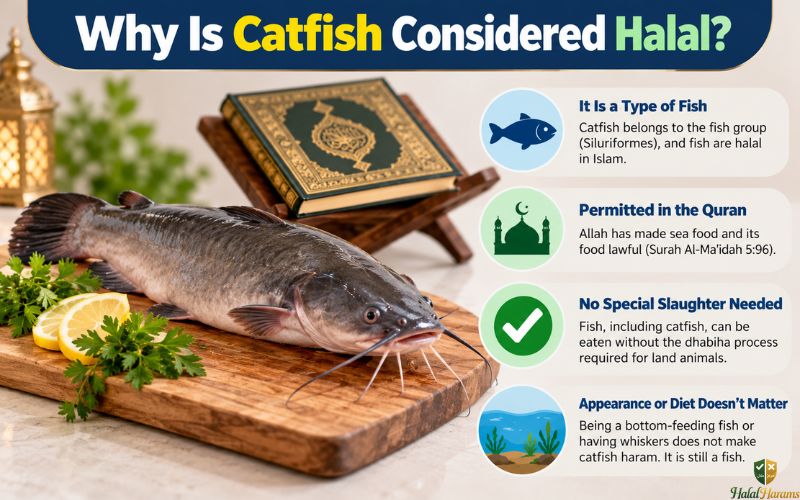
The key point is classification. Catfish is not a strange non-fish water creature; it belongs to the fish group known scientifically as Siluriformes. NOAA records numerous freshwater catfish species within this order.
This matters particularly in Hanafi fiqh because the school distinguishes fish from other aquatic animals. A Hanafi ruling does not depend on whether a fish looks attractive, lives near the bottom, or eats unusual food.
So, a catfish does not become haram because it has whisker-like barbels or because it is commonly found in muddy or slow-moving water.
What Does the Quran Say About Fish?
One of the important Quranic references is Surah Al-Ma’idah 5:96, which permits sea game and its food. Scholars have used this verse when discussing the permissibility of aquatic food.
The verse is especially relevant because Muslims sometimes assume that seafood must be treated like land animals and therefore require slaughter. Fish are different in this respect.
The general Islamic principle is that fish may be eaten without the normal slaughter procedure required for land animals. This is why Muslims can eat fish that has been caught, cleaned, and prepared without performing dhabiha.
Related Post: Is Jello Halal? Complete Guide For Muslims(2026)
Is Catfish Halal According to the Hanafi School?
Yes. Catfish is halal according to Hanafi fiqh because it is a type of fish.
Hanafi scholars explain that fish are permissible among aquatic animals. A detailed Hanafi discussion states that all types of fish are halal, although a fish that dies naturally without an external cause and floats on the water has a separate ruling.
This means that the fact that catfish is a bottom-dwelling fish does not create a problem. The same basic classification applies whether the fish is caught in a river, lake, pond, or another body of water.
What About the Other Sunni Madhhabs?
The other Sunni schools also recognize the permissibility of fish. The broader discussion of seafood differs between the schools, particularly regarding creatures that are not fish.
The majority position among Maliki, Shafi’i, and Hanbali jurists is generally broader concerning aquatic animals. They rely on the Quranic permission concerning sea food and permit aquatic creatures more widely, although individual details and exceptions can differ.
Catfish does not create the same controversy as creatures such as crab or certain unusual aquatic animals because it is clearly classified as a fish.
| Madhhab | General position relevant to catfish |
|---|---|
| Hanafi | Halal because catfish is a fish |
| Maliki | Halal |
| Shafi’i | Halal |
| Hanbali | Halal |
Does Catfish Need to Be Slaughtered?
No. Catfish does not require dhabiha slaughter in the way that cattle, sheep, chickens, and other land animals do.
Fish have a different legal ruling. A Muslim can catch a catfish and eat it after preparing it properly without performing the conventional slaughter used for land animals.
This is one reason fish is convenient for Muslims living in places where halal meat may be difficult to find. However, the ingredients and cooking method still need attention if the catfish is prepared as part of a restaurant meal.
What If Catfish Dies Before It Is Caught?
This is where a small but important Hanafi detail appears.
Hanafi jurists distinguish between a fish that dies because of an external cause and a fish that dies naturally in the water and then floats on the surface. The latter is known in classical discussions as samak al-tafi and has a different ruling.
For example, if a catfish is caught by a net, hook, or another ordinary fishing method and then dies, this is not the same situation as finding a dead fish floating naturally on the water.
| Situation | General Hanafi guidance |
|---|---|
| Catfish caught alive | Halal |
| Catfish caught with a fishing net | Halal |
| Catfish dies after being caught | Halal |
| Catfish dies from an external cause | Generally halal |
| Catfish naturally dies and floats | Separate Hanafi ruling |
Does a Catfish’s Diet Affect Its Halal Status?
Some people question catfish because these fish can feed near the bottom of rivers, lakes, and ponds. Their diet can include various aquatic organisms and organic matter.
That fact by itself does not make catfish haram. Hanafi scholars specifically state that fish are halal generally, regardless of what they eat, as long as the animal is actually a fish. Darul Ifta Deoband, for example, states that all types of fish are halal and even discusses predatory fish such as sharks under this principle.
So, a catfish does not become prohibited simply because of its feeding habits.
Is Farm-Raised Catfish Halal?
Yes. Farm-raised catfish is halal for the same basic reason: it is still a fish.
Whether the catfish comes from a commercial fish farm, river, lake, or another legitimate source does not change its basic classification. Farming may affect questions of quality, cleanliness, or food safety, but those are separate from the fundamental halal ruling.
A Muslim buying frozen or fresh catfish should therefore focus on the product itself and how it is prepared rather than worrying that farm-raised catfish is automatically haram.
Related Post: Are Jolly Ranchers Halal? Complete Guide For Muslims(2026)
Can Muslims Eat Catfish at Restaurants?
Yes, Muslims can eat catfish at restaurants, provided the other ingredients and preparation are halal.
Plain grilled or fried catfish is generally straightforward. The concern may arise from the coating, marinade, sauces, cooking oil, or shared cooking equipment.
For example, a restaurant may fry catfish in oil that is also used for prohibited foods. A breading mixture may contain questionable ingredients, or a sauce may contain alcohol.
| Restaurant Catfish | What to Check |
|---|---|
| Grilled catfish | Seasonings and sauces |
| Fried catfish | Batter and frying oil |
| Catfish sandwich | Bread, sauces, and cheese |
| Catfish with sauce | Sauce ingredients |
| Catfish platter | All side dishes and cooking methods |
Is Catfish Halal If It Is Cooked With Alcohol?
The fish itself remains a halal type of food, but adding a haram ingredient to a dish creates a separate issue.
If a catfish dish is prepared with wine, cooking alcohol, or another prohibited ingredient, Muslims should not simply ignore that ingredient because the main food is fish.
When ordering at a restaurant, ask about marinades, sauces, and cooking ingredients if you are uncertain. A plain preparation is usually easier to assess than a complicated dish containing several sauces.
Common Misconceptions About Catfish
A few myths cause unnecessary confusion.
One is that bottom-feeding fish are haram. There is no general Islamic rule saying that fish become haram because they feed near the bottom of a river or lake.
Another misconception is that catfish must be slaughtered because it is an animal. Fish have their own ruling and do not require the normal dhabiha process.
Some people also think that catfish is questionable because it does not have the familiar appearance of fish such as salmon. Its appearance does not change its classification.
What About Catfish Found Dead?
This question should be handled carefully, especially by Hanafi Muslims.
If a catfish is found dead in water and is floating because it died naturally without an external cause, Hanafi jurists give this situation a different ruling from a fish that was caught and subsequently died.
This distinction is mainly relevant when someone finds a dead fish rather than purchasing normally caught or farmed fish. In ordinary shopping, restaurant dining, or commercial fishing, this unusual situation generally does not arise.
Related Post: Is Tuna Halal? A Complete Guide For Muslims(2026)
Is Catfish Halal During Ihram?
Fish and seafood have a special ruling during Ihram. The Quran specifically permits sea game and its food while restricting land hunting for a person in the state of Ihram.
Therefore, catching and eating fish is not treated like hunting prohibited land game during Ihram. A person performing Hajj or Umrah should still follow the detailed rules of Ihram and the guidance of a qualified scholar for specific circumstances.
For ordinary Muslims outside Ihram, this issue does not affect the basic ruling on catfish.
How Should Muslims Check Catfish at the Store?
Buying plain catfish is usually simple. Look at the product label and determine whether it is simply fish or whether it has already been seasoned, breaded, marinated, or processed.
Plain fresh or frozen catfish does not need a halal meat certification in the same way processed meat products might. However, processed products can contain additional ingredients that should be checked.
| Product | What Muslims Should Check |
|---|---|
| Fresh catfish | Usually straightforward |
| Frozen plain catfish | Ingredient list and additives |
| Breaded catfish | Coating and flavorings |
| Seasoned catfish | Seasoning and marinade |
| Ready-made catfish meal | All ingredients |
Is Catfish Healthy to Eat?
From an Islamic perspective, health benefits are not what make catfish halal. The halal ruling comes from the nature and legal classification of the food.
From a practical food perspective, catfish is widely consumed as a source of fish protein. Its nutritional value can vary depending on the species, farming method, portion size, and cooking method.
So Muslims can consider nutrition and food safety separately after establishing that the food itself is halal.
What Should You Do If You Follow Hanafi Fiqh?
If you follow the Hanafi school, you can generally eat catfish because it is a fish. There is no requirement for you to locate a halal slaughterhouse for ordinary catfish.
The main unusual issue is the rule concerning fish that dies naturally and floats. That situation is quite different from buying catfish from a fish seller or eating a properly caught catfish at home or in a restaurant.
If a particular situation is unclear, especially when the fish was found dead rather than caught, ask a qualified Hanafi scholar for a ruling based on the circumstances.
Frequently Asked Questions
Is catfish halal in Islam?
Yes. Catfish is a type of fish, and fish are generally halal to eat. This applies across the Sunni schools, with detailed differences mainly concerning other aquatic animals.
Is catfish halal according to Hanafi fiqh?
Yes. Hanafi jurists consider all types of fish halal, including catfish. A separate ruling applies to fish that naturally die and float without an external cause.
Does catfish need to be slaughtered?
No. Fish do not require the normal Islamic slaughter process used for land animals. Catfish can be eaten after being properly caught and prepared.
Is farm-raised catfish halal?
Yes. Farm-raised catfish remains a fish and is halal. The farming method does not itself make catfish haram, although ingredients used in processed products should be checked.
Can Muslims eat fried catfish?
Yes, provided the batter, seasoning, oil, and other ingredients are halal. At restaurants, check whether the same oil is used for prohibited foods.
Is catfish halal if it eats dirty things?
Yes. A fish does not become haram simply because of its normal feeding habits. Catfish remains halal because it is classified as a fish.
Practical Takeaway: Is Catfish Halal?
Yes, catfish is halal. It is a genuine type of fish, and fish are permissible to eat under Islamic law. The Quran permits sea food, and Hanafi jurists specifically include fish among permissible aquatic animals.
For everyday Muslims, there is usually no need to worry about the catfish’s appearance, habitat, or diet. The main things to watch are unusual circumstances, such as finding a fish that died naturally and floated, or eating processed catfish containing questionable ingredients.
If you are ordering catfish at a restaurant, simply check the batter, sauces, seasonings, and cooking method. For the question “Is catfish halal?” the straightforward answer is yes.
