
If you are wondering is Bitcoin halal, the answer depends on the scholarly opinion you follow and how you use it. Some Islamic scholars consider Bitcoin permissible under certain conditions, while others raise concerns about speculation, excessive uncertainty, and its use in unlawful transactions. This disagreement leaves many Muslims unsure whether buying, selling, or holding Bitcoin is allowed in Islam.
Bitcoin is a digital asset that people use to transfer value, make investments, and trade online. Unlike traditional money, it is not issued by a central bank, and its price can change sharply within a short time. These features raise important questions about Islamic rules concerning wealth, trade, gambling, and financial risk.
In this guide, we will examine the Quranic principles, relevant Hadith, different scholarly opinions, and practical situations Muslims face when dealing with cryptocurrency. The goal is to help you understand when Bitcoin may be considered permissible, why some scholars prohibit it, and what to check before making a financial decision.
Is Bitcoin Halal or Haram? The Short Answer
Bitcoin is a disputed issue in Islamic finance. Some scholars permit owning and trading it under specific conditions, while others consider it impermissible because of concerns about uncertainty, speculation, and financial harm. There is no single ruling accepted by all Islamic scholars worldwide.
The ruling may also depend on the transaction. Buying Bitcoin to hold as a digital asset is not necessarily the same as gambling on short-term price movements, paying interest on a crypto loan, or trading highly leveraged contracts.
| Bitcoin activity | Islamic concern | General assessment |
|---|---|---|
| Buying Bitcoin to hold | Ownership and asset permissibility | Disputed among scholars |
| Selling Bitcoin you own | Valid sale and transfer of ownership | Potentially permissible under a permissive view |
| Day trading based on price movements | Speculation and gambling-like behavior | Depends on the method and intention |
| Interest-bearing crypto loans | Riba (interest) | Generally prohibited |
| Leveraged futures and perpetual contracts | Leverage, uncertainty, and contract structure | Frequently considered impermissible |
| Using Bitcoin for unlawful purchases | Prohibited purpose | Not permissible |
These are general guidelines, not a binding fatwa. The exact ruling depends on the transaction’s structure and the scholarly approach being followed.
What Is Bitcoin and How Does It Work?
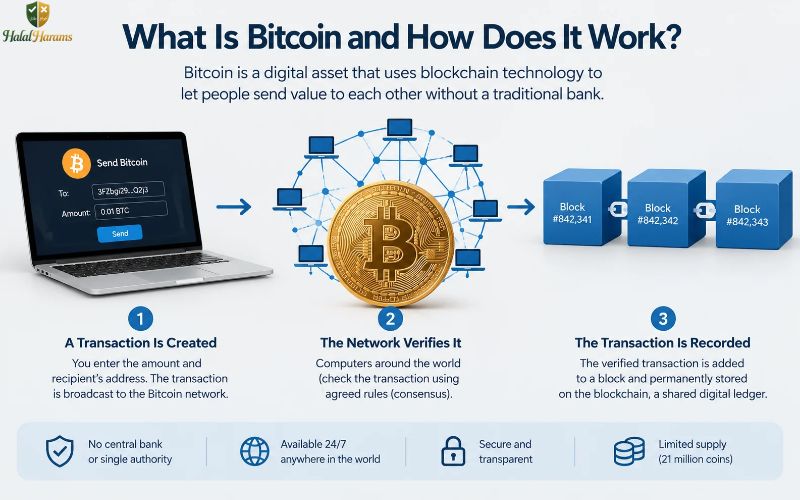
Bitcoin is a form of digital asset that exists on a computer network. It uses blockchain technology, which records transactions on a shared digital ledger. People can send Bitcoin to one another without relying on a traditional bank to process every transfer.
Bitcoin is not backed by a government or a physical commodity such as gold. Its market price mainly depends on supply, demand, public confidence, and market activity.
There is also a fixed maximum supply of 21 million bitcoins under its existing protocol. However, limited supply does not guarantee that its price will increase or that investors will make a profit.
For Islamic finance, the key question is whether Bitcoin can be recognized as lawful wealth and whether the way it is acquired, sold, or used meets Shariah requirements.
What Does Islam Say About Bitcoin?
The Quran does not mention Bitcoin by name because cryptocurrency developed centuries after the revelation. Muslims must therefore evaluate it through broader Islamic principles governing trade, wealth, contracts, and financial conduct.
Three important principles help explain the debate.
- Permissible trade: Surah Al-Baqarah 2:275 distinguishes lawful trade from prohibited interest.
- Mutual consent: Surah An-Nisa 4:29 prohibits consuming one another’s wealth unjustly and requires trade to be conducted by mutual agreement.
- Avoiding gambling: Surah Al-Ma’idah 5:90 warns believers against gambling, which is known as maysir in Islamic law.
These principles are relevant to cryptocurrency, but they do not automatically establish that every Bitcoin transaction is halal or haram. Scholars must assess its nature and the details of each transaction. القرآن الكريم
Related Post: Is Milk Halal? Complete Islamic Rulings on Milk(2026)
Is Bitcoin Riba?
Bitcoin itself is not automatically interest. Buying an asset at an agreed price and later selling it for a higher price is not the same as receiving interest on a loan.
However, if a Bitcoin transaction involves an interest-bearing loan or a prohibited interest payment, that part of the arrangement raises a separate Shariah problem.
Surah Al-Baqarah 2:275 clearly distinguishes lawful trade from riba. A person cannot make an interest-based contract permissible simply by using cryptocurrency instead of ordinary money. Translation
Why Do Some Scholars Consider Bitcoin Halal?
Scholars who permit Bitcoin under certain conditions generally focus on its potential status as a recognized digital asset or form of wealth. They may argue that physical existence is not necessary for something to have financial value.
People already own many assets that are not physical objects, including contractual rights and certain digital property. Under this approach, Bitcoin’s electronic form alone does not make it prohibited.
The permissive view still requires lawful dealings. The buyer should understand the transaction, obtain genuine ownership or control, avoid interest-based arrangements, and stay away from fraud and gambling-like practices.
A price that changes frequently does not, by itself, prove that an asset is haram. Many lawful goods also experience price changes. The question is whether the transaction involves unacceptable uncertainty, prohibited conditions, or harmful conduct.
Conditions That Support a Permissible View
| Condition | What it means in practice |
|---|---|
| Lawful purpose | Bitcoin is not being used to purchase prohibited goods or services |
| Genuine ownership | The buyer obtains the Bitcoin or a valid, recognized ownership right |
| Clear transaction | The price, quantity, and terms are understood |
| No riba | The arrangement does not involve prohibited interest |
| No gambling | The activity is not a wager or a gambling-based contract |
| No deception | The buyer avoids fraud, manipulation, and misleading claims |
Meeting these conditions does not settle every scholarly disagreement. A scholar may still consider Bitcoin itself unsuitable as currency or property under their understanding of Islamic commercial law.
Why Do Some Scholars Consider Bitcoin Haram?
Scholars who prohibit Bitcoin often raise concerns about its uncertain legal and financial status, extreme price movements, speculative activity, and potential for misuse.
Some also question whether Bitcoin satisfies the requirements for recognized wealth or a valid means of exchange under Islamic jurisprudence. If a scholar does not recognize it as a lawful asset, that position can lead to a prohibition on buying, selling, or investing in it.
For example, Pakistan’s Jamia Uloom Islamia, Banuri Town, has published fatwas advising against Bitcoin transactions and investment. Its reasoning includes the position that Bitcoin cannot be treated as recognized currency or wealth for these purposes. Banuri+1
These rulings represent a particular scholarly position, not proof that every Islamic scholar has reached the same conclusion.
Related Post: Is Lamb Halal or Haram? Can Muslims Eat It(2026)
Is Bitcoin Haram Because Its Price Is Unstable?
Not necessarily, according to the permissive approach. Price volatility is a risk, but financial risk alone does not make every transaction gambling.
The concern becomes stronger when someone places money on a short-term price movement without a sound trading arrangement, uses extreme leverage, or behaves as though trading were a game of chance.
A person buying an asset with the intention of owning it is in a different situation from someone entering a wager-like contract. Scholars examine the contract itself, not merely whether the person makes or loses money.
Difference Between Bitcoin and Gambling in Islam?
Islam prohibits gambling because it involves wagering and acquiring wealth through an impermissible game of chance. Bitcoin trading, however, does not automatically fall into this category simply because its price is unpredictable.
The difference lies in the nature of the activity, the contract, and the risks involved.
| Example | How to understand it Islamically |
|---|---|
| Buying Bitcoin with the intention of owning it | Disputed; depends on the scholarly ruling and transaction |
| Selling owned Bitcoin at a profit | Profit alone does not make the sale haram |
| Betting money on a price outcome | Raises serious gambling concerns |
| Using extreme leverage to chase quick profits | May involve prohibited contract terms and excessive speculation |
| Joining a scheme promising guaranteed crypto returns | Requires scrutiny for fraud, deception, and possible riba |
A Muslim should not assume that every profitable trade is halal or that every losing trade is haram. The underlying arrangement matters more than the financial result.
What Do Different Islamic Scholars Say About Bitcoin?
There is no universally accepted ruling on Bitcoin across Islamic scholarship. Different scholars assess its status using established principles of Islamic commercial law, including ownership, customary recognition of wealth, uncertainty, and financial harm.
The International Islamic Fiqh Academy addressed electronic currencies in Resolution No. 237 (8/24) in 2019. Rather than issuing a blanket ruling that Bitcoin is halal or haram, the Academy identified questions about cryptocurrency’s legal and financial nature and recommended further research because of its risks and transaction instability. International Islamic Fiqh Academy
The disagreement reflects differences in how scholars understand digital assets and their place in financial transactions.
Do All Four Madhhabs Have the Same Ruling?
The Hanafi, Maliki, Shafi’i, and Hanbali schools developed their principles of trade long before Bitcoin existed. It would be inaccurate to claim that all four schools issued a single, agreed ruling on cryptocurrency.
Contemporary scholars apply these schools’ legal principles to new financial products. They may differ on whether Bitcoin qualifies as recognized wealth, whether its risks are excessive, and whether its use as currency or an investment is acceptable.
For this reason, Muslims should look for a reasoned ruling from a qualified scholar familiar with both Islamic commercial law and the actual cryptocurrency transaction, rather than relying on an unsupported claim about a particular madhhab.
Related Post: Is Sugar Alcohol Halal? Complete Guide For Muslims
Is Buying Bitcoin for Long-Term Investment Halal?
Long-term ownership is different from gambling on rapid price changes, but a longer holding period does not automatically make Bitcoin permissible.
A Muslim considering Bitcoin as an investment should first determine whether they follow a scholarly position that recognizes it as a lawful asset. They should then examine how the purchase is funded, whether ownership is genuine, and whether the investment involves prohibited lending or contractual arrangements.
Consider this example: Ahmad buys a small amount of Bitcoin using his available money and holds it in a wallet he controls. Bilal borrows money through an interest-bearing arrangement to buy Bitcoin using leveraged trading.
Their situations are not identical. Ahmad’s purchase still falls within the broader scholarly disagreement over Bitcoin itself, while Bilal’s arrangement adds a separate concern involving interest and leverage.
Is Bitcoin Spot Trading Halal?
Spot trading generally means buying an asset at the current market price rather than entering a derivative contract based on its future price. It may avoid some concerns associated with leveraged futures, but it does not resolve the disagreement about Bitcoin’s underlying status.
Under a permissive scholarly view, a spot purchase may be acceptable if the asset is recognized as lawful wealth, the transaction is genuine, and the applicable rules of ownership and exchange are satisfied.
A spot label alone is not enough. Some platforms may provide only a contractual claim rather than actual control of Bitcoin, so users should understand what they are purchasing.
Are Bitcoin Futures, Leverage, and Staking Halal?
Different cryptocurrency products require separate rulings. A decision about owning Bitcoin cannot automatically be applied to every service offered by a crypto platform.
| Activity | Main Shariah concern |
|---|---|
| Futures and perpetual contracts | Contract structure, speculation, and possible prohibited settlement arrangements |
| Margin trading | Interest-bearing borrowing and excessive leverage |
| Lending Bitcoin for a guaranteed interest return | Riba |
| Crypto staking | Depends on the protocol, reward mechanism, and actual activity |
| Bitcoin mining | Requires lawful operations, valid compensation, and consideration of applicable costs and rules |
Futures and perpetual contracts are frequently considered impermissible by scholars who object to their structure and speculative features. The exact contract should be reviewed rather than assuming every product works the same way.
Staking also needs careful distinction. Bitcoin uses proof-of-work mining, not the proof-of-stake system used by certain other cryptocurrencies. Services marketed as Bitcoin staking may actually involve lending, pooled investment, or other arrangements.
Related Post: Are Oysters Halal? Complete Islamic Rulings(2026)
Is Bitcoin Mining Halal?
Bitcoin mining involves computers competing to validate transactions and add blocks to the blockchain through a proof-of-work process. Successful miners may receive protocol rewards and transaction fees.
Mining is not automatically haram simply because it involves cryptocurrency or consumes electricity. Its ruling depends on the broader scholarly position on Bitcoin, the legitimacy of the activity, and the way it is conducted.
A miner should also consider electricity costs, contractual obligations, local regulations, and whether the operation involves deception or misuse of resources. Mining rewards do not remove the need to assess the underlying asset under Shariah.
Can Muslims Use Bitcoin to Buy Goods and Send Money?
Using Bitcoin for payment raises many of the same questions as investment, but the practical purpose may be different.
Someone who transfers Bitcoin to pay for a lawful service is not necessarily doing the same thing as someone speculating on its market price. However, the permissibility of the underlying asset and the payment arrangement remains disputed.
| Situation | What should be checked? |
|---|---|
| Paying for a lawful product | Whether Bitcoin is accepted as a permissible means of payment under the ruling followed |
| Sending money to family | Ownership, transfer fees, local law, and the asset’s Shariah status |
| Paying for prohibited goods | The unlawful purpose of the transaction |
| Receiving Bitcoin as business income | Whether the underlying work and payment arrangement are lawful |
| Transferring Bitcoin to conceal criminal proceeds | Deception, unlawful activity, and legal violations |
In Pakistan, Muslims should also check the applicable local rules before using or investing in cryptocurrency. A religious ruling and a country’s legal requirements are separate matters; satisfying one does not automatically satisfy the other.
Do Muslims Have to Pay Zakat on Bitcoin?
Zakat on Bitcoin is another area where the answer depends partly on how the asset is classified under Islamic law.
If a qualified scholar recognizes Bitcoin as zakatable wealth, the usual questions include whether the amount reaches the applicable nisab, whether the required lunar year has passed where that condition applies, and how the value should be calculated.
Bitcoin held for trade may be assessed differently from assets held for other purposes under some juristic approaches. The details of the person’s total zakatable wealth also matter.
Because scholars disagree about Bitcoin’s status, it is best to ask a qualified scholar how the rules apply to your holdings, local currency, and circumstances. Do not assume that every crypto balance is automatically exempt from zakat.
Common Misconceptions About Bitcoin and Islam
Several claims about Bitcoin circulate online without enough explanation. These are worth clearing up before making a financial decision.
- “Bitcoin is digital, so it must be haram.” Physical form alone does not settle whether something qualifies as wealth under Islamic law.
- “Bitcoin is popular, so it must be halal.” Public acceptance does not replace Shariah analysis.
- “All cryptocurrency profits are gambling.” The nature of the contract and the activity must be examined.
- “If I buy and hold Bitcoin, every concern disappears.” Long-term ownership does not resolve the underlying disagreement.
- “Every crypto reward is interest.” Rewards must be assessed according to their actual source and contractual structure.
These distinctions help Muslims avoid both unsupported blanket claims and overly confident assurances that all cryptocurrency activity is permissible.
Related Post: Is Tyson Chicken Halal? Can Muslims Eat It(2026)
Frequently Asked Questions
Is Bitcoin halal in Islam?
Scholars disagree. Some permit Bitcoin under specific conditions, while others prohibit it because of concerns about its status as wealth, uncertainty, speculation, and potential harm.
Is Bitcoin haram according to the Hanafi school?
There is no single classical Hanafi ruling specifically about Bitcoin. Contemporary Hanafi scholars differ in their assessment of cryptocurrency and apply established principles of Islamic commercial law.
Is Bitcoin trading halal if I do not use leverage?
Avoiding leverage removes certain concerns, including some interest-related arrangements, but it does not settle whether Bitcoin itself or the particular trading activity is permissible.
Is holding Bitcoin halal?
Holding Bitcoin is permitted by some contemporary scholars under specific conditions and prohibited by others. The answer depends on the scholarly position and the nature of ownership.
Can Muslims earn money from Bitcoin?
A profit is not automatically halal simply because money was earned. The underlying asset, purchase, sale, funding method, and any prohibited contract terms must be assessed.
Is Bitcoin halal in Pakistan?
Islamic scholars in Pakistan hold differing views, and some local religious institutions advise avoiding it. Muslims should also check applicable Pakistani laws and seek a qualified, current ruling.
Final Verdict: Should Muslims Invest in Bitcoin?
The question “is Bitcoin halal?” does not have one universally accepted answer. Some contemporary scholars allow Bitcoin ownership and trading under specific conditions, while others prohibit it because of concerns about its status as wealth, uncertainty, speculation, and financial risk.
The practical approach is to avoid interest-based crypto loans, gambling-like contracts, deceptive schemes, and investments you do not understand. Before buying Bitcoin, ask a qualified scholar to assess the actual transaction, including whether you will own the asset, how the purchase is funded, and which scholarly ruling applies to your circumstances.
If you follow a scholar or institution that prohibits Bitcoin, the cautious course is to follow that guidance. If you are considering a permissive opinion, make sure you understand its conditions rather than treating it as approval for every cryptocurrency product.

1 comment