
Crab is a popular seafood enjoyed in many countries. It can be boiled, grilled, fried, or added to soups and other dishes. Since Islam has rules about which types of seafood Muslims can eat, many people ask, “Is crab halal?”
The answer depends on the Islamic school of thought you follow. Many Muslim scholars consider crab halal because it is a sea animal, and they allow seafood in general. This view is common among the Shafi’i, Maliki, and Hanbali schools.
However, the Hanafi school has a different view. Hanafi scholars generally consider only fish from sea animals to be permissible, so crab is not considered halal according to the traditional Hanafi position.
How the crab is prepared also matters. Crab itself may be permissible, but a dish could become unsuitable if it contains haram ingredients, such as alcohol or pork-based ingredients.
In this guide, you will learn what Islamic scholars say about crab, why the schools of thought differ, and what Muslims should check before eating crab. Understanding these differences can help you follow the ruling of the Islamic school you trust while making informed food choices.
Is Crab Halal or Haram?
Short Answer
Crab is considered halal by many scholars, especially in the Shafi‘i, Maliki, and Hanbali schools, but it is considered makruh or not permissible by the Hanafi school.
What Is Crab?
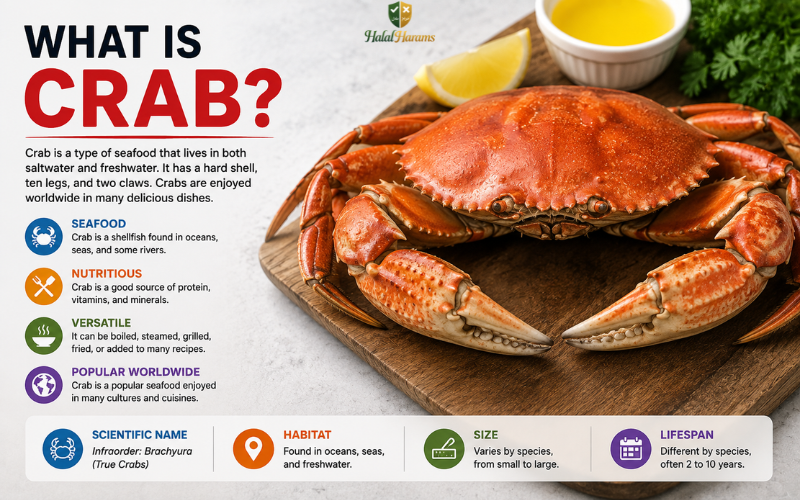
Crab is a type of crustacean that lives in oceans, rivers, and coastal areas. It has:
- A hard shell
- Multiple legs
- The ability to live both in water and briefly on land
This “amphibious-like” nature is one reason scholars differ in opinion.
Why Halal Status Matters
Islamic dietary laws divide food into:
- Halal (permissible)
- Haram (forbidden)
- Makruh (discouraged)
Seafood has its own rulings, which vary among schools of thought.
Understanding these differences is essential.
General Islamic View on Seafood
The Quran permits seafood broadly, especially in this verse:
“Lawful to you is what you catch from the sea…”
However, scholars interpret this differently.
General Seafood Rulings
| School of Thought | Seafood Ruling |
|---|---|
| Hanafi | Only fish allowed |
| Shafi‘i | All sea creatures halal |
| Maliki | All sea creatures halal |
| Hanbali | Mostly all sea creatures halal |
This difference directly affects the ruling on crab.
Is Crab Halal According to Each School?
Crab Ruling by Madhhab
| School | Ruling on Crab |
|---|---|
| Hanafi | ❌ Not halal / Makruh |
| Shafi‘i | ✅ Halal |
| Maliki | ✅ Halal |
| Hanbali | ✅ Halal |
Majority of scholars consider crab halal.
Why Some Scholars Say Crab Is Not Halal
The Hanafi school has stricter rules.
Reasons include:
- Only fish are considered halal seafood
- Crab is not classified as a fish
- Crab lives partially outside water
Therefore, it is considered makruh tahrimi (strongly disliked) or not permissible.
Why Many Scholars Say Crab Is Halal
Other schools allow all sea creatures.
Reasons include:
- General Quranic permission of seafood
- Crab lives primarily in water
- No clear prohibition
This leads to the permissibility view.
Related Post: Is KFC Halal
Types of Crab and Their Rulings
Not all crabs are exactly the same.
Crab Types
| Type | Halal Status |
|---|---|
| Sea crab | ✅ Halal (majority view) |
| Freshwater crab | ⚠️ Depends |
| Land crab | ⚠️ More disputed |
Sea crabs are generally more accepted.
Is Crab Considered a Fish?
This is a key issue.
Classification
| Feature | Crab | Fish |
|---|---|---|
| Has scales | ❌ No | ✅ Yes |
| Lives in water | ✅ Yes | ✅ Yes |
| Shell | ✅ Yes | ❌ No |
Because crab is not a fish, some scholars reject it.
Cooking and Preparation
Even if crab is halal, preparation matters.
Cooking Considerations
| Factor | Halal Status |
|---|---|
| Cooked separately | ✅ Halal |
| Mixed with alcohol | ❌ Haram |
| Cooked with haram meat | ❌ Haram |
Cooking method must also be halal.
Cross-Contamination Risks
Seafood restaurants may handle multiple items.
Cross-Contamination
| Area | Risk |
|---|---|
| Cooking surfaces | Medium |
| Utensils | Medium |
| Fryers | High |
Shared equipment can create issues.
Nutritional Benefits of Crab
Crab is not only tasty but also nutritious.
Nutrition Overview
| Nutrient | Benefit |
|---|---|
| Protein | High |
| Omega-3 | Heart health |
| Vitamins | B12, Zinc |
It is a healthy seafood option.
Related Post: Is Alligator Halal? Complete Guide for Muslims
Health Considerations
While crab is beneficial, moderation is important.
Health Factors
| Factor | Impact |
|---|---|
| Cholesterol | Moderate |
| Sodium | Can be high |
| Allergies | Possible |
Always consume responsibly.
Common Misconceptions
“All seafood is halal”
Not according to all schools.
“Crab is clearly haram”
Majority of scholars consider it halal.
“Fish rules apply to all seafood”
Different interpretations exist.
How to Decide If You Should Eat Crab
Your decision may depend on:
- Your school of thought
- Personal level of caution
- Availability of halal alternatives
Follow what aligns with your beliefs.
Scholarly Opinions Summary
Final Scholarly Summary
| Opinion Type | View |
|---|---|
| Majority | Crab is halal |
| Hanafi | Crab is not permissible |
| Cautious | Avoid if unsure |
Respect differences of opinion.
Why This Topic Matters
Understanding whether crab is halal is important because:
- It is widely consumed
- Scholarly opinions differ
- It helps Muslims follow their dietary guidelines
FAQs
Is crab halal in Islam?
It depends on the school of thought. Most scholars consider it halal.
Is crab halal in the Hanafi school?
No, it is considered not permissible or makruh.
Is crab halal in Shafi‘i school?
Yes, it is halal.
Can Muslims eat crab?
Yes, according to most scholars, but not according to Hanafi opinion.
Is crab healthier than fish?
It is nutritious but should be eaten in moderation.
What is the safest option?
Follow your school of thought or consult a scholar.
Final Remarks
The question of whether crab is halal highlights the diversity within Islamic jurisprudence. While the majority of scholars from the Shafi‘i, Maliki, and Hanbali schools consider crab to be halal due to the general permissibility of seafood, the Hanafi school takes a more cautious approach and does not classify crab as permissible. This difference stems from varying interpretations of what qualifies as halal seafood. For Muslims, the best approach is to follow the guidance of their preferred school of thought or consult a trusted scholar. Ultimately, Islam allows flexibility in such matters, and respecting differing opinions is important while making informed and conscious dietary choices.
