
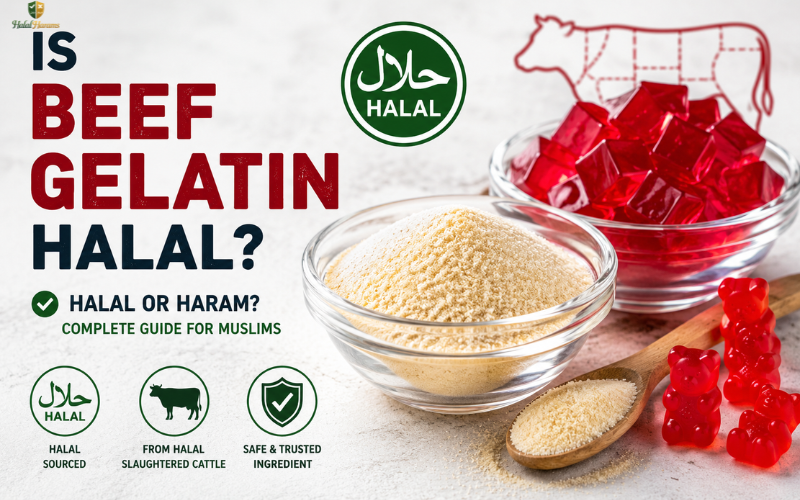
If you are wondering “Is beef gelatin halal?”, the short answer is: it can be halal, but the word “beef” alone does not guarantee that it is halal. Beef gelatin is made from collagen taken from cattle, usually from bones, skin, or connective tissues. For Muslims, the important question is not only which animal the gelatin comes from, but also whether the cattle were permissible, how they were slaughtered, and how the gelatin was processed. This is why two products labeled “beef gelatin” may not have the same Islamic status.
Some are halal-certified and suitable for Muslims, while others need further checking. Understanding the source of the gelatin and the relevant fiqh principles can help Muslims make a confident choice when buying sweets, capsules, desserts, supplements, or other processed foods.
Is Beef Gelatin Halal or Haram?
Beef gelatin is generally halal when it comes from halal cattle that were slaughtered according to Islamic requirements and the gelatin contains no prohibited ingredients.
However, simply seeing “beef gelatin” or “bovine gelatin” on a package is not enough to establish halal status in every case.
| Type of gelatin | General Islamic concern |
|---|---|
| Halal-certified beef gelatin | Generally halal |
| Beef gelatin from properly slaughtered cattle | Generally halal |
| Beef gelatin from unknown animal source | Needs verification |
| Beef gelatin from non-halal slaughtered cattle | Scholarly discussion; certification is safest |
| Pork gelatin | Haram |
| Fish gelatin | Generally halal, depending on the source and ingredients |
| Plant-based gelling agents | Usually halal if other ingredients are permissible |
For everyday food choices, halal-certified bovine gelatin is the clearest option because it confirms the source and production standards rather than leaving the consumer to guess.
What Is Beef Gelatin?
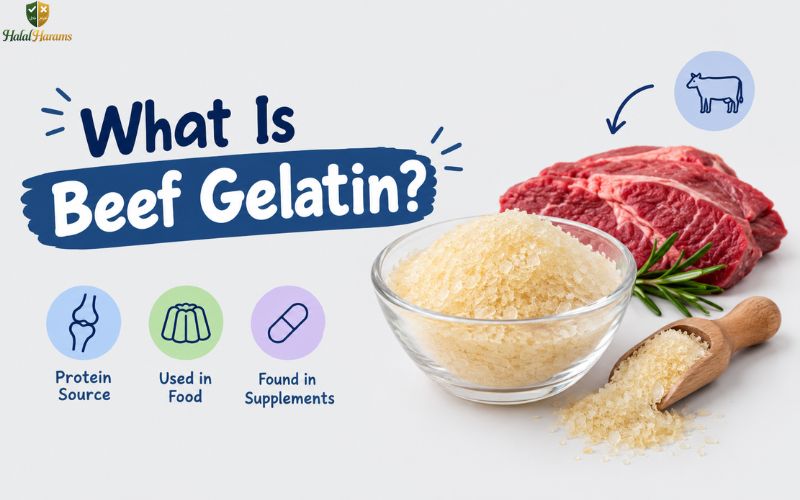
Beef gelatin, also called bovine gelatin, is a protein made from collagen found in cattle.
Manufacturers commonly obtain collagen from cattle bones, hides, and connective tissues. The material is processed so that the collagen becomes gelatin, which can dissolve and form a gel when used in food.
Gelatin is widely used because it has useful properties. It can give foods their shape, improve texture, stabilize products, and create the soft or chewy consistency found in many sweets and desserts.
| Product | Why beef gelatin may be used |
|---|---|
| Gummies | Creates a chewy texture |
| Marshmallows | Helps create structure |
| Jelly desserts | Forms a gel |
| Yogurt products | Improves texture |
| Capsules | Forms the capsule shell |
| Desserts | Provides firmness and stability |
So when Muslims see gelatin on an ingredient list, the first question should be: What is the source of this gelatin?
How Is Beef Gelatin Made?
The process begins with collagen-rich cattle material, such as bones or hides. Manufacturers clean and treat this material to extract collagen.
The collagen then goes through several processing stages that eventually produce gelatin. The final substance may look very different from the original animal tissue.
This creates an important fiqh question: does processing change the Islamic ruling of the original animal material?
Scholars discuss this under the principle known as istihalah, meaning a substantial transformation of a substance into something different.
Related Post: Is Pork Halal? The Clear Islamic Ruling on Pork and Pig Products
Why Does the Source of Beef Gelatin Matter?
The word “beef” only tells you that the gelatin came from cattle. It does not automatically tell you whether the cattle were slaughtered according to Islamic requirements.
Cattle are a halal species. But Islamic dietary law also considers the method of slaughter when meat and certain animal-derived products are concerned.
For this reason, halal certification can be useful when buying bovine gelatin.
A product may say “100% bovine gelatin”, yet provide no information about slaughter or halal certification. Another product may specifically state “halal bovine gelatin.”
For a Muslim who wants to avoid uncertainty, the second option provides much clearer information.
Is Bovine Gelatin Halal If It Comes From Cow Bones?
It can be halal, provided the source and processing meet the relevant Islamic requirements.
Cow bones themselves are not from a haram animal because cattle are permissible animals. The main concern is how the animal died and how the material was obtained.
If the bovine gelatin is produced from cattle that were properly slaughtered according to Islamic requirements, it is generally considered permissible by scholars who require the halal source for animal-derived gelatin.
Some fiqh discussions become more complicated when bones or tissues come from animals that were not slaughtered Islamically. This is one reason halal certification matters.
Does Halal Slaughter Matter for Beef Gelatin?
For many halal standards and scholars, yes.
A cow is a halal animal, but an animal can still become impermissible for consumption if it dies in a prohibited manner or is not slaughtered according to the applicable Islamic rules.
The same principle is relevant when animal tissues are used to produce food ingredients.
| Label on product | What you can understand |
|---|---|
| “Beef gelatin” | Confirms bovine source only |
| “Bovine gelatin” | Confirms cattle source, not necessarily halal slaughter |
| “Halal bovine gelatin” | Indicates halal compliance under the certifier’s standard |
| “Porcine gelatin” | Pork-derived and haram |
| “Gelatin – source unspecified” | Source should be confirmed |
This is why Muslims should not assume that bovine = automatically halal.
What Do Islamic Scholars Say About Beef Gelatin?
The general position is that gelatin from a halal animal can be permissible when the animal source and processing meet Islamic requirements.
There is also a scholarly discussion about istihalah, or complete transformation. Some jurists give significant legal effect to a genuine transformation in which an original impure substance becomes a fundamentally different substance.
Other scholars take a stricter approach and do not consider ordinary commercial gelatin processing sufficient to change the original ruling.
This difference is especially relevant when gelatin comes from questionable or non-halal animal sources.
For a product already made from properly halal-slaughtered cattle, this particular concern is much easier to resolve.
Is Beef Gelatin Halal According to All Four Madhabs?
The four Sunni madhabs agree that cattle are a halal species. The more detailed discussion concerns issues such as slaughter, animal parts, impurity, and whether processing constitutes istihalah.
It would therefore be inaccurate to say that every gelatin question has exactly the same answer in all four schools.
| Madhab | General relevance to bovine gelatin |
|---|---|
| Hanafi | Discusses animal-derived substances and transformation within broader purity principles |
| Maliki | Gives significant attention to transformation and purity questions |
| Shafi’i | Takes detailed positions concerning animal-derived substances and impurity |
| Hanbali | Also considers source, purity, slaughter, and transformation principles |
For consumers, the practical point is simple: a halal-certified bovine gelatin product avoids much of the uncertainty surrounding unknown sources.
Related Post: Is Jello Halal? Complete Guide For Muslims(2026)
Is Beef Gelatin Halal Without Cow Halal Slaughtered?
This is a more complicated question than simply asking whether gelatin is made from beef.
Some scholars and halal authorities do not consider gelatin from non-halal-slaughtered cattle permissible because the original animal source was not obtained through valid Islamic slaughter.
Other juristic discussions consider whether the manufacturing process creates sufficient istihalah to change the ruling.
Because there is genuine scholarly disagreement around transformation, a Muslim who follows a particular madhab or halal standard should follow the position of a trusted scholar or certification body.
For general shopping, choosing halal-certified bovine gelatin is the straightforward way to avoid this disagreement.
Is Beef Gelatin Better Than Pork Gelatin?
From an Islamic perspective, they cannot simply be treated as interchangeable.
Pork comes from an animal that is explicitly prohibited in the Quran. Pork-derived gelatin is therefore generally regarded as haram.
Beef comes from a halal animal, so bovine gelatin has the potential to be halal when the necessary requirements are met.
| Gelatin source | Islamic status |
|---|---|
| Halal-certified cattle | Halal |
| Properly halal-slaughtered cattle | Generally halal |
| Unknown cattle source | Needs checking |
| Non-halal slaughtered cattle | Scholarly discussion |
| Pig | Haram |
| Fish | Generally permissible, subject to product ingredients |
The difference between porcine gelatin and bovine gelatin is therefore significant.
How Can You Tell If Beef Gelatin Is Halal?
Start with the ingredient list. Look for terms such as bovine gelatin, beef gelatin, or halal bovine gelatin.
The strongest practical indication is a recognized halal certification on the product. If there is no certification, check the manufacturer’s information about the source of the cattle and slaughter method.
You should also check whether the product contains other questionable ingredients.
For example, a gummy candy might contain halal bovine gelatin but also contain another animal-derived ingredient whose source is unclear. Looking at gelatin alone does not establish that the entire product is halal.
Is “Bovine Gelatin” the Same as “Halal Gelatin”?
No.
Bovine describes the animal source. Halal describes whether the ingredient meets Islamic requirements.
This distinction is easy to overlook.
A label saying “bovine gelatin” is useful because it tells you the gelatin is not necessarily from pork. But it does not always provide enough information about slaughter, processing, certification, or other ingredients.
For Muslims who want certainty, halal-certified bovine gelatin is preferable to relying only on the word “bovine.”
Where Is Beef Gelatin Commonly Used?
Beef gelatin is found in many products that do not obviously look like animal-based foods.
It may appear in gummy sweets, marshmallows, desserts, capsules, certain dairy products, nutritional products, and other processed foods.
This is why checking gelatin is especially important for Muslims who regularly buy imported foods.
A product can contain no visible meat at all and still contain an animal-derived ingredient.
Related Post: Is Gelatin Halal? Complete Guide for Muslims(2026)
Can Muslims Eat Candy Made With Beef Gelatin?
Yes, if the beef gelatin is halal and the other ingredients are also permissible.
For example, halal-certified bovine gelatin can be used to produce gummy sweets that are suitable for Muslims.
But if a candy simply says “gelatin” without identifying the source, it is reasonable to investigate before eating it.
The same applies to marshmallows, jelly sweets, and similar products.
What About Beef Gelatin in Medicine Capsules?
Medicine capsules can raise a separate fiqh question.
Many capsules use gelatin because it forms a suitable shell around medication. If the gelatin is halal-certified bovine gelatin, the concern is generally much lower.
If the capsule contains gelatin from an unclear or prohibited source, the ruling can depend on the medicine’s necessity, available alternatives, and the specific nature of the ingredient.
A person should not stop essential medication merely because the capsule contains gelatin. For medical cases, the actual medicine and available alternatives should be discussed with a qualified healthcare professional and knowledgeable Islamic scholar.
Common Misconceptions About Beef Gelatin
One common mistake is thinking “all gelatin is haram.” That is not correct. Gelatin can come from cattle, pigs, fish, and other sources, and the Islamic ruling depends on the source and relevant processing.
Another mistake is thinking “all beef gelatin is automatically halal.” The word beef identifies the animal species but does not necessarily confirm halal slaughter or certification.
A third misconception is that gelatin is always treated exactly like ordinary meat. Gelatin involves processing and raises separate fiqh questions, particularly concerning transformation.
What Should Muslims Do When the Gelatin Source Is Unknown?
If a food contains simply “gelatin” and the source is not stated, do not assume it is halal.
You can check whether the product has halal certification, ask the manufacturer about the gelatin source, or choose a product clearly made with halal-certified bovine or plant-based alternatives.
| Situation | Practical choice |
|---|---|
| Halal-certified beef gelatin | Suitable |
| Bovine gelatin with verified halal source | Generally suitable |
| Gelatin source clearly stated as pork | Avoid |
| Gelatin source not stated | Check before consuming |
| Plant-based pectin or agar | Usually suitable if other ingredients are halal |
This small habit can make packaged-food shopping much easier.
Is Beef Gelatin Halal? The Detailed Answer
So, is beef gelatin halal? The answer is yes when it comes from a halal source and meets the relevant Islamic requirements.
The fact that gelatin comes from cattle is an important positive factor because cattle are a halal animal. But Muslims should still consider slaughter, sourcing, processing, and certification.
Where gelatin comes from cattle that were not slaughtered Islamically, scholars differ over the effect of processing and istihalah. Because of that difference, halal-certified bovine gelatin is the safest practical choice for consumers who want to avoid doubtful ingredients.
Related Post: Is Sushi Halal? A Complete Guide for Muslims
Frequently Asked Questions
Is beef gelatin halal in Islam?
Beef gelatin can be halal when it comes from permissible cattle and meets Islamic requirements, especially when the source is verified or halal-certified.
Is bovine gelatin the same as pork gelatin?
No. Bovine gelatin comes from cattle, while pork gelatin comes from pigs. Their Islamic rulings are different because cattle are a halal species.
Is all beef gelatin automatically halal?
No. “Beef” identifies the animal source but does not necessarily confirm halal slaughter, processing, or certification.
Can Muslims eat gummies made with beef gelatin?
Yes, if the beef gelatin is halal and the remaining ingredients are also halal. Halal certification provides useful assurance about the complete product.
Is halal-certified bovine gelatin permissible?
Generally yes. Halal certification indicates that the bovine gelatin has been produced according to the requirements of the relevant halal certifying standard.
What should I do if a product only says “gelatin”?
Check the source before consuming it. If the manufacturer does not identify the source, choose a clearly halal-certified gelatin product or another suitable alternative.
Practical Takeaway
The simple answer to “Is beef gelatin halal?” is yes, it can be halal, but beef gelatin should not be assumed halal solely because it comes from cattle.
The best practical choice is halal-certified bovine gelatin, particularly for sweets, marshmallows, desserts, capsules, and other processed foods. If a product only says “gelatin,” check its source rather than guessing.
Remember the key distinction: bovine tells you where the gelatin comes from; halal tells you whether it meets Islamic requirements. When the source or processing is unclear, choosing a verified halal alternative removes unnecessary doubt.
