
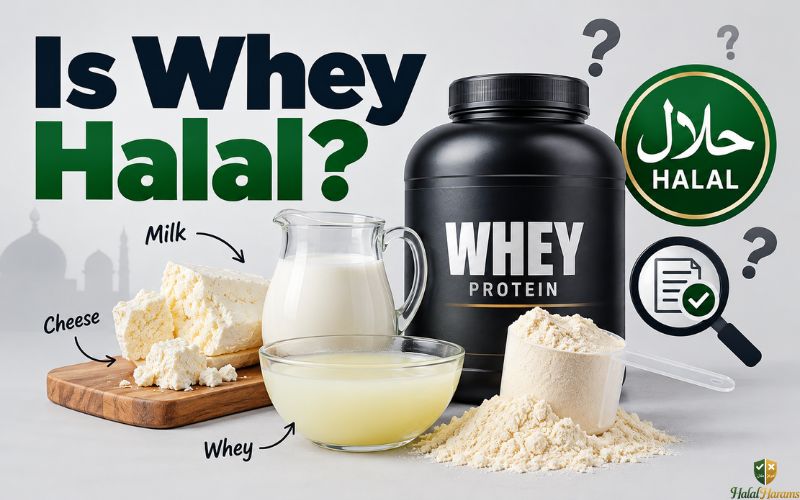
If you have ever checked a whey protein tub and wondered, “Is whey halal?”, you are not alone. Whey comes from milk, which is halal, but the process used to make certain dairy products can introduce ingredients that need closer attention. The biggest question usually involves rennet, an enzyme traditionally used to separate milk into curds and whey.
Other ingredients in whey protein powders, such as flavors, emulsifiers, sweeteners, and processing aids, can also affect the final ruling. In general, pure whey from halal milk is halal, and whey protein can also be halal when its ingredients and manufacturing process do not contain prohibited substances.
However, not every whey product should automatically be treated as halal simply because it comes from milk.
Is Whey Halal or Haram?
Whey is generally halal. Whey is the liquid portion of milk that remains after milk is separated during cheese-making or similar dairy processing.
The basic ingredients involved are not inherently haram. Milk from permissible animals, such as cows and goats, is halal. The question becomes more complicated when enzymes, cultures, flavorings, or other processing ingredients are added.
| Whey product | General ruling |
|---|---|
| Pure whey from halal milk | Halal |
| Whey protein with halal-certified ingredients | Halal |
| Whey made using microbial rennet | Halal |
| Whey made using vegetarian rennet | Halal |
| Whey containing clearly haram ingredients | Haram |
| Whey with questionable or unknown processing ingredients | Requires investigation |
So, if you are drinking ordinary whey or using a whey protein powder, the word “whey” itself is not a reason to consider the product haram.
What Exactly Is Whey?
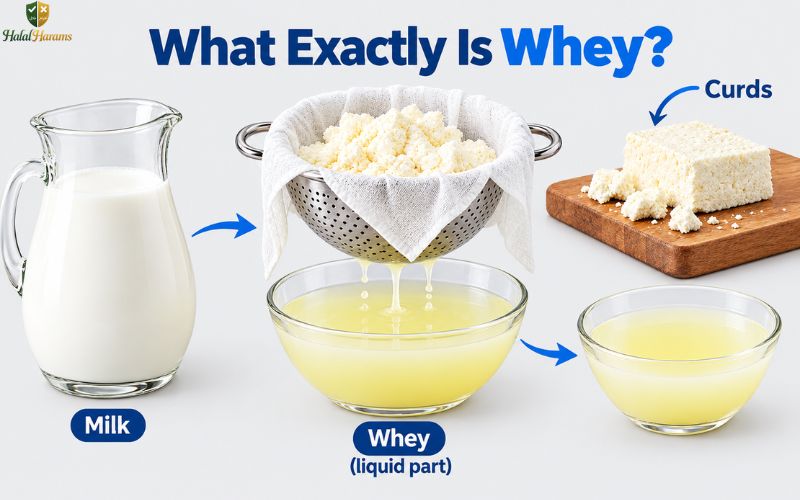
Whey is a natural dairy liquid produced when milk is separated into solid curds and liquid whey.
During cheese production, milk undergoes a process that separates its major components. The curds are used to make cheese, while the remaining liquid is whey.
Whey contains proteins, lactose, minerals, water, and other components naturally found in milk.
This matters because some people assume whey is an animal-derived ingredient in the same way as gelatin. It is not. Whey itself is a dairy product.
The concern comes mainly from how the milk was processed, especially when rennet or other enzymes are involved.
Why Does Rennet Matter in Whey?
Rennet is an enzyme traditionally used to help coagulate milk during cheese production.
Traditional animal rennet can be obtained from the stomach lining of young animals. Because of this animal origin, Muslims naturally want to know where the animal came from and how it was slaughtered.
There are also modern alternatives.
| Type of rennet | Common source | Halal consideration |
|---|---|---|
| Animal rennet | Animal enzymes | Depends on source and slaughter |
| Microbial rennet | Microorganisms | Generally halal |
| Fermentation-produced enzymes | Controlled fermentation | Usually halal if ingredients are permissible |
| Vegetarian rennet | Plant/microbial sources | Generally halal |
This is one reason two whey products can look almost identical while requiring different ingredient checks.
Related Post: Is HI-CHEW Halal? Complete Guide for Muslims(2026)
Is Whey Protein Halal?
Whey protein is generally halal when its ingredients and manufacturing process comply with Islamic dietary requirements.
Plain whey protein concentrate or isolate starts with milk and is processed to increase its protein content.
The issue is that commercial protein powders rarely contain whey alone.
They may contain:
- Whey protein concentrate
- Whey protein isolate
- Cocoa
- Flavorings
- Lecithin
- Sweeteners
- Stabilizers
- Enzymes
- Creamers
- Vitamins and minerals
Most of these ingredients are not automatically problematic. However, some flavor systems, enzymes, emulsifiers, or other processing ingredients may come from animal or alcohol-based sources.
That is why checking the whole ingredient list is more useful than looking only at the word “whey.”
Is Whey Protein Powder Halal Without Certification?
It can be halal, but certification makes the question easier.
If a whey protein powder has a trustworthy halal certification, Muslims can generally rely on that certification for the product’s stated formulation.
If there is no halal logo, that does not automatically mean the product is haram.
You should instead examine the ingredients and, when necessary, ask the manufacturer about unclear components.
| Label situation | What you should do |
|---|---|
| Recognized halal certification | Generally acceptable |
| Simple ingredients with clearly halal sources | Usually acceptable |
| Animal-derived enzyme listed | Investigate source |
| “Natural flavors” without further information | Ask manufacturer if significant |
| Gelatin listed | Check its source |
| Alcohol listed as an ingredient | Investigate carefully |
| Unclear proprietary blend | Contact manufacturer |
A lack of certification is different from evidence that a product contains haram ingredients.
Is Whey From Cheese Halal?
Whey produced during cheese-making is generally halal provided the ingredients and processing used to make the cheese are permissible.
This is where rennet becomes especially relevant.
For example, cheese made using microbial rennet does not raise the same animal-source concern as cheese made with animal rennet.
If the rennet comes from a permissible animal that was slaughtered according to Islamic requirements, many scholars consider its use permissible.
There are also differences among scholars regarding certain forms of animal rennet and the status of rennet obtained from animals not slaughtered according to Islamic requirements.
Because of these differences, someone following a particular madhhab may want to follow the ruling of a qualified scholar familiar with that school’s position.
What Do Different Madhhabs Say About Rennet?
The discussion surrounding rennet is older and more detailed than modern whey protein itself.
Classical jurists discussed whether rennet taken from animals is considered pure and whether its ruling changes depending on the animal’s slaughter.
There are differences among the four Sunni schools and among individual scholars regarding particular circumstances.
The practical point is simple: scholarly disagreement about rennet does not mean whey itself is automatically haram.
The ruling can depend on the source of the rennet, the animal involved, the method of preparation, and the madhhab being followed.
| Situation | Practical concern |
|---|---|
| Microbial rennet | No animal-slaughter issue |
| Vegetarian rennet | No animal-slaughter issue |
| Halal animal rennet | Generally considered permissible |
| Rennet from non-halal animal | Not permissible |
| Rennet from an improperly slaughtered animal | Scholarly disagreement exists |
| Unknown rennet source | Check with manufacturer or scholar |
If you normally follow a particular madhhab, consistency with that school’s established ruling is sensible.
Related Post: Is Jello Halal? Complete Guide For Muslims(2026)
Does Whey Contain Pork?
Whey itself does not naturally contain pork.
Whey comes from milk, not pork.
However, a finished whey protein product can contain other ingredients derived from animals. For example, gelatin may sometimes be used in food products, although it is not an inherent part of whey.
This is why Muslims should distinguish between whey as an ingredient and a finished whey protein supplement.
The first is naturally dairy-based. The second may contain numerous additional ingredients.
Is Whey Protein Isolate Halal?
Whey protein isolate is generally halal because it is produced from milk and contains a high percentage of protein.
The word “isolate” refers to processing and purification. It does not mean the protein comes from an animal other than a dairy animal.
Still, the final product must be considered as a whole.
Check the flavoring system, enzymes, sweeteners, emulsifiers, capsules if applicable, and other added ingredients.
A plain whey isolate with a halal certification is straightforward. An unflavored product with a short, transparent ingredient list is also easier to assess than a complex multi-ingredient formula.
Is Whey Protein Concentrate Halal?
Yes, whey protein concentrate can be halal.
Whey concentrate is made by processing whey to increase the concentration of protein while retaining varying amounts of lactose, minerals, and other milk components.
The nutritional difference between concentrate and isolate does not create a different Islamic ruling by itself.
The halal question still comes down to the source and processing.
| Type | Basic source | General halal status |
|---|---|---|
| Whey concentrate | Milk whey | Halal |
| Whey isolate | Milk whey | Halal |
| Hydrolyzed whey | Processed whey protein | Halal if ingredients/process are permissible |
| Whey blend | Whey plus other ingredients | Check complete formula |
Can Muslims Take Whey Protein After Exercise?
Yes. Muslims can use halal whey protein as a nutritional supplement after exercise.
There is nothing inherently impermissible about consuming protein for fitness, strength, or nutritional needs.
The same Islamic dietary principles apply whether you drink whey at breakfast, after a workout, or at another time.
If the product contains permissible ingredients, its use is permissible.
The key is not the purpose for which you consume whey. The key is what the product contains and how questionable ingredients were sourced.
Related Post: Are Nerds Gummy Clusters Halal? Complete Guide for Muslims (2026)
What Ingredients Should You Check?
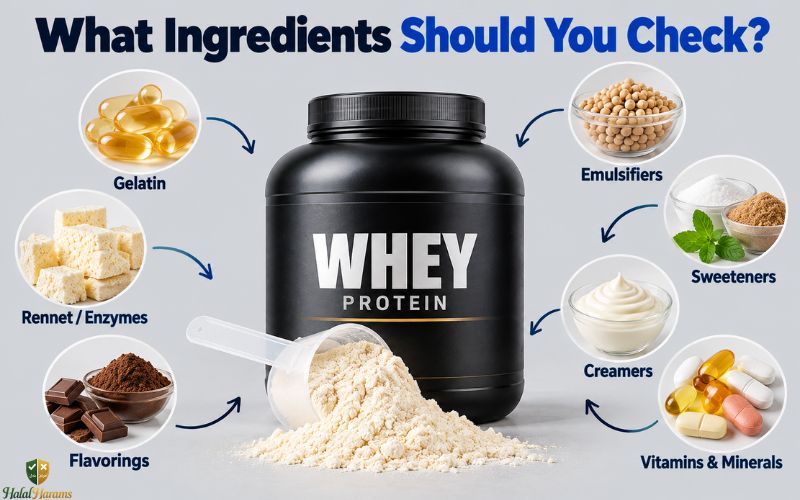
When buying whey protein, do not stop after seeing “whey protein” on the front of the package.
Turn the container around and read the ingredient list.
Pay particular attention to:
- Gelatin — determine its source.
- Rennet or enzymes — check whether they are animal, microbial, or otherwise sourced.
- Flavorings — ask about unclear animal or alcohol-derived components.
- Emulsifiers — most are permissible, but source can matter.
- Creamers — check their complete composition.
- Alcohol-containing ingredients — distinguish between ingredient use and trace processing issues, as scholarly rulings can differ.
For a complex product, contacting the manufacturer is often the quickest way to remove uncertainty.
What Does the Quran Say About Halal Food?
The Quran establishes the broader principle that Muslims should consume what is lawful and good.
Allah says in the Quran:
“Eat of what is lawful and good on the earth.”
Quran 2:168
Another well-known verse instructs believers to eat from the good and lawful provisions Allah has provided.
These principles form the foundation for checking food ingredients rather than assuming that every processed product is automatically permissible.
Islamic dietary law also distinguishes between clearly halal, clearly haram, and matters that require further investigation.
What If You Already Drank Whey Without Checking?
If you consumed a whey protein product without knowing its ingredients, do not panic.
You should first find out what was actually in the product.
If you later discover that an ingredient was questionable, that is different from knowingly consuming something established to be haram.
Islamic rulings consider knowledge, intention, uncertainty, and circumstances. A person should not turn ordinary food-label uncertainty into unnecessary anxiety.
For a specific situation involving a known haram ingredient, ask a qualified local scholar about what you should do.
Relsted Post: Are Welch’s Fruit Snacks Halal? Complete(2026)
How Can You Tell if Whey Is Halal?
Use this simple checklist before purchasing:
| Check | Question |
|---|---|
| 1 | Does it have reliable halal certification? |
| 2 | Is the main protein clearly derived from milk? |
| 3 | Does it contain animal rennet or enzymes? |
| 4 | Is gelatin present? |
| 5 | Are flavorings or other additives unclear? |
| 6 | Can the manufacturer confirm questionable ingredients? |
If the product passes these checks, you can make a much more informed decision.
Common Misconceptions About Whey
“Whey comes from animals, so it must be haram.”
Not correct. Milk from halal animals is halal, and whey is produced from milk.
“All cheese whey is automatically halal.”
Not necessarily. Processing ingredients such as rennet may require investigation.
“No halal logo means haram.”
No. Certification provides assurance, but its absence alone does not establish that a product is haram.
“All animal rennet is haram.”
This is too broad. Scholars have discussed different circumstances and there are differences in fiqh regarding certain sources.
A Practical Halal Whey Checklist
If you are standing in a store with a whey protein tub in your hand, keep the decision simple.
First, check whether it has reliable halal certification.
Second, read the ingredient list rather than relying on the product name.
Third, investigate rennet, enzymes, gelatin, and unclear flavoring ingredients.
Fourth, if the manufacturer gives a clear answer about questionable ingredients, keep that information for future purchases.
Finally, if the issue involves a genuine fiqh disagreement and you follow a particular madhhab, ask a qualified scholar whose methodology you trust.
The basic answer remains straightforward: whey itself is halal. The concern usually lies in the ingredients and processing used to produce a particular whey or whey protein product.
Related Post: Is Beef Gelatin Halal? Complete Guide for Muslims (2026)
FAQs About Whether Whey Is Halal
Is whey naturally halal?
Yes. Whey comes from milk, and milk from halal animals is permissible. The processing ingredients used to produce the whey may still need checking.
Is whey protein halal for Muslims?
Generally, yes. Whey protein is halal when its ingredients, enzymes, flavorings, and manufacturing process do not involve prohibited substances.
Is whey made from cheese halal?
Usually, yes, but the cheese-making process matters. Rennet and other processing ingredients can affect the ruling, particularly when animal-derived enzymes are used.
Is whey protein isolate halal?
Whey protein isolate is generally halal because it comes from milk. Check additional ingredients and processing aids, especially in flavored products.
Does whey protein contain pork?
Pure whey does not come from pork. However, some finished products may contain additional animal-derived ingredients, so check the complete ingredient list.
Should I only buy halal-certified whey?
Halal certification is a useful way to verify a product, but certification is not the only way to establish permissibility. Ingredient sources can also be investigated.
Practical takeaway
Is whey halal? Yes, generally. Plain whey comes from milk and is not inherently haram. The main concern is usually the ingredients and processing used to make a particular whey protein product.
When buying whey protein, check the complete ingredient list, especially rennet, enzymes, gelatin, flavorings, emulsifiers, and other animal-derived ingredients. A reliable halal certification can provide additional assurance.
If an ingredient has an unclear source, contact the manufacturer before consuming the product. If you follow a particular madhhab or have a specific concern about rennet or another ingredient, consult a qualified local scholar or imam for guidance.
