
Glycerin is found in many everyday products, from food and sweets to medicines, cosmetics, toothpaste, and skincare. The concern for Muslims is understandable: is glycerin halal, or can it come from a haram source such as pork? The short answer is that glycerin itself is not automatically haram. Its Islamic ruling depends mainly on where it comes from and how it is produced. Glycerin made from vegetable oils or halal animal fats is generally halal, while glycerin derived from pork is generally considered haram. When the source is not stated, the product cannot always be declared haram simply because it contains glycerin.
Glycerin, also called glycerol, is a clear, colorless and slightly sweet liquid. It is widely used because it attracts and holds moisture. That is why you may find it in foods, medicines, toothpaste, soaps, lotions, and other everyday products.
Is Glycerin Halal or Haram?
Glycerin can be halal or haram depending on its source.
The word glycerin or glycerol describes a chemical substance. It does not, by itself, tell us whether the ingredient came from plants, animals, or another manufacturing process.
| Glycerin source | General ruling |
|---|---|
| Vegetable oils | Halal |
| Halal animal fat | Generally halal |
| Pork fat | Haram |
| Unknown source | Needs investigation |
| Synthetic glycerin | Generally halal |
So, when you see glycerin on a food, medicine, or cosmetic label, the next question should be: What is the source of the glycerin?
What Is Glycerin Made From?
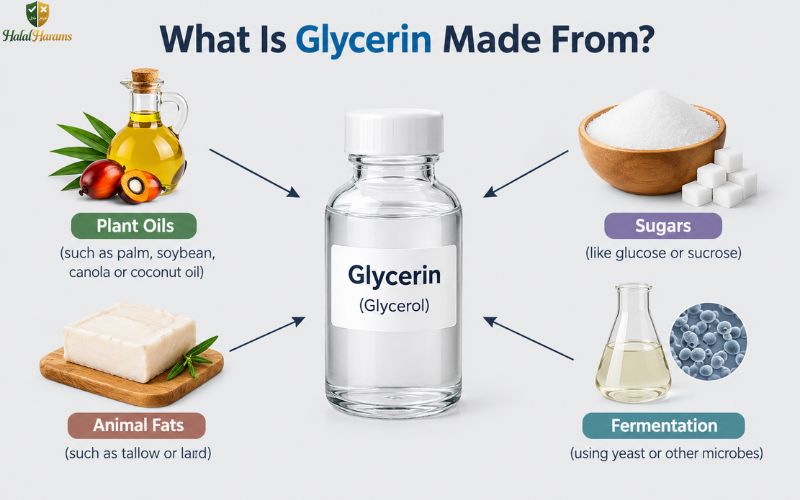
Commercial glycerin can come from several sources. Vegetable glycerin is usually produced from oils such as palm, coconut, soybean, rapeseed, or other plant oils.
Animal-derived glycerin can also be produced from fats. The Islamic ruling then depends on the animal and, where relevant, how the animal was slaughtered and how the material was processed.
There is also synthetic glycerin, which is produced through chemical manufacturing rather than directly extracting it from an animal or plant.
What Are the Main Sources of Glycerin?
Understanding the source makes the halal question much easier.
| Source | Example | Halal concern |
|---|---|---|
| Plant-based | Coconut or palm oil | Usually no concern |
| Halal animal | Beef or sheep fat | Slaughter requirements may matter |
| Pork | Pig fat | Haram |
| Synthetic | Chemical manufacturing | Generally halal |
| Unspecified | Label only says “glycerin” | Source should be checked |
This is why simply seeing the word glycerin on an ingredient list is not enough to make a final ruling.
Related Post: Is Beef Gelatin Halal? A Clear Islamic Guide to Bovine Gelatin
Is Vegetable Glycerin Halal?
Yes, vegetable glycerin is generally halal.
Vegetable glycerin is made from plant oils rather than animal fat. Common sources include coconut, palm, soybean, and other vegetable oils.
Since plants are generally permissible for consumption under Islamic dietary principles, glycerin produced from permissible plant sources is not normally considered problematic.
For Muslims looking for halal skincare, food products, toothpaste, or supplements, vegetable glycerin is usually a suitable ingredient.
Still, the term “vegetable glycerin” should not be confused with every product simply labeled “glycerin.” The source should be confirmed when halal status matters.
Is Animal-Derived Glycerin Halal?
Animal-derived glycerin requires more detail.
If glycerin comes from an animal that is permissible to eat, such as cattle or sheep, scholars may consider factors including how the animal was slaughtered and what happened during processing.
If the source is a halal animal and the relevant Islamic requirements are fulfilled, the glycerin can generally be considered permissible.
If it comes from an animal that Muslims cannot eat, such as a pig, the ruling is different.
| Ingredient source | General Islamic status |
|---|---|
| Vegetable glycerin | Halal |
| Pork-derived glycerin | Haram |
| Halal animal-derived glycerin | Generally halal |
| Synthetic glycerin | Generally halal |
| Unknown glycerin | Source should be investigated |
Is Pork Glycerin Haram?
Glycerin derived from pork is generally considered haram.
Pork and its derivatives are prohibited in Islam. The Quran explicitly prohibits swine flesh, including in Surah Al-Baqarah 2:173 and Surah Al-Ma’idah 5:3.
Therefore, if a manufacturer confirms that its glycerin is derived from pork fat, Muslims should avoid that product for consumption.
The difficult question is often not the chemistry. It is identifying the original source.
Does Glycerin in Food Make It Haram?
Not necessarily.
Glycerin is used in food for several reasons. It can help retain moisture, improve texture, prevent drying, and sometimes contribute sweetness.
You may find it in baked goods, candy, chewing gum, fillings, processed foods, and other products.
The presence of glycerin alone does not make food haram. What matters is its source and the manufacturing process.
What About Glycerin in Medicines?
Medicines can present a slightly different situation because glycerin may be used as a solvent, sweetener, humectant, or ingredient in liquid formulations.
If the glycerin is vegetable-based or synthetic, there is generally no issue from the glycerin itself.
If it is animal-derived, Muslims may need more information about the source. For essential medication, questions of necessity can also affect the practical ruling.
A person should not stop prescribed medicine simply because the ingredient list contains the word “glycerin.” Ask the pharmacist or manufacturer about the source, and consult a qualified scholar when the situation requires a specific ruling.
Is Glycerin in Cosmetics Halal?
Glycerin is very common in cosmetics and personal-care products.
It helps skin retain moisture, which is why it appears in moisturizers, lotions, soaps, creams, lip products, and other formulations.
| Product | Why glycerin is used |
|---|---|
| Moisturizer | Helps retain moisture |
| Soap | Improves moisture retention |
| Toothpaste | Helps prevent drying |
| Lip balm | Helps keep the product smooth |
| Lotion | Acts as a humectant |
| Makeup | Helps maintain texture |
For cosmetics, the main halal question is again the source.
Plant-based and synthetic glycerin are generally straightforward. Animal-derived glycerin deserves further checking.
Related Post: Is Jello Halal? Complete Guide For Muslims(2026)
How Can You Tell If Glycerin Is Halal?
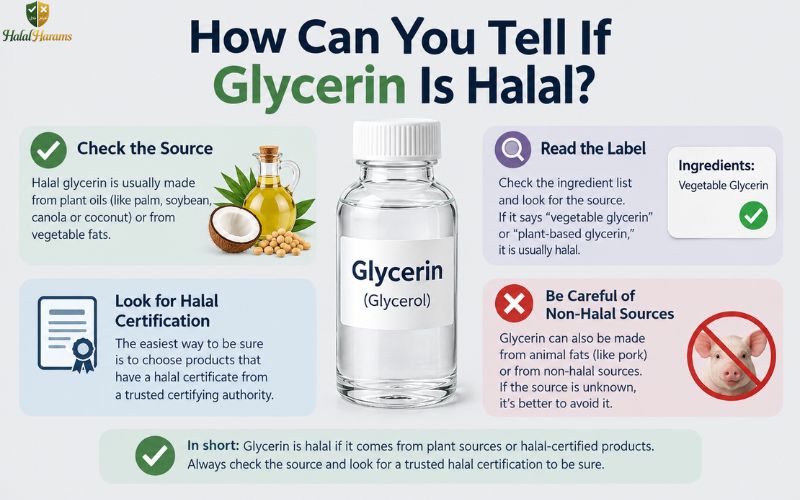
The easiest approach is to check the product information and, when necessary, ask the manufacturer.
Look for terms such as:
- Vegetable glycerin
- Vegetable-derived glycerin
- Plant-based glycerin
- Synthetic glycerin
- Halal-certified glycerin
If the package only says “glycerin,” do not automatically assume that it is pork-derived.
That assumption is not justified merely from the ingredient name.
Does the Ingredient List Tell You the Source?
Often, no.
Ingredient labels may identify the chemical ingredient without explaining its original source. This is one reason halal-conscious consumers sometimes need to contact the manufacturer.
A useful question is:
“Is the glycerin used in this product plant-derived, synthetic, or animal-derived? If animal-derived, what animal is it sourced from?”
This is much more useful than simply asking whether the product is “safe.”
What About Glycerin E422?
Glycerin is also known as glycerol and may be identified as E422 in food ingredient systems.
E422 refers to glycerol used as a food additive. The E-number itself does not tell you whether the glycerol came from a plant or animal source.
| Label | What it means |
|---|---|
| Glycerin | Common name |
| Glycerol | Chemical name |
| E422 | Food additive designation |
| Vegetable glycerin | Plant-derived glycerin |
| Synthetic glycerin | Manufactured glycerin |
Therefore, seeing E422 does not automatically mean halal or haram. The source still matters.
What Do Islamic Principles Say About Glycerin?
Islamic dietary rulings are based on the nature and source of substances, along with relevant principles concerning purity, transformation, necessity, and harm.
The Quran clearly establishes the prohibition of pork and other clearly prohibited foods. At the same time, not every ingredient with a complicated manufacturing history should automatically be treated as haram.
Hadith and established principles of Islamic jurisprudence provide scholars with a framework for dealing with substances and circumstances that are not specifically named in revelation.
This is particularly relevant to modern food processing, where an ingredient’s original source may not be obvious from its final chemical form.
Does Chemical Processing Change the Ruling?
This is one of the more complicated areas of Islamic jurisprudence.
The concept of istihalah, or substantial transformation, is discussed by Muslim jurists when a prohibited substance undergoes significant transformation into something fundamentally different.
Scholars have differing views about how broadly this principle applies to modern industrial processing. Some transformations may be considered legally significant, while others may not meet the required standard.
Because glycerin can be produced through different processes, it would be inaccurate to give one blanket ruling for every animal-derived glycerin without knowing the facts.
For ordinary consumers, identifying a plant-based or synthetic source is usually the clearest practical approach.
Do Different Madhhabs Treat Glycerin Differently?
The four Sunni schools of jurisprudence—Hanafi, Maliki, Shafi’i, and Hanbali—share the fundamental prohibition of pork and other clearly prohibited substances.
Differences can arise in detailed questions involving transformation, impurity, manufacturing processes, and necessity.
| Issue | General area of scholarly discussion |
|---|---|
| Pork-derived material | Prohibited |
| Plant-derived glycerin | Generally permissible |
| Synthetic glycerin | Generally permissible |
| Animal-derived glycerin | Source and circumstances matter |
| Chemical transformation | Details can differ among scholars |
For this reason, a complex industrial ingredient may receive different answers depending on the facts and the juristic approach being followed.
Related Post: Is Whey Halal? A Muslim’s Guide to Whey Protein
Is Glycerin Haram If the Source Is Unknown?
Unknown does not automatically mean haram.
This distinction is important.
If a product simply lists “glycerin,” there may be no evidence that it came from pork. At the same time, a consumer who follows a strict halal standard may reasonably want confirmation before using or consuming it.
There is a difference between saying:
“The source is unknown.”
and saying:
“The glycerin is from pork.”
The first is uncertainty. The second is a known prohibited source.
When possible, investigate rather than making assumptions in either direction.
Practical Halal Checklist for Glycerin
Before buying a product containing glycerin, use this simple checklist:
| Step | What to do |
|---|---|
| 1 | Check the ingredient list |
| 2 | Look for “vegetable” or “plant-based” |
| 3 | Check for halal certification |
| 4 | Contact the manufacturer if needed |
| 5 | Ask specifically about the glycerin source |
| 6 | Consult a scholar for difficult cases |
This approach works for food, medicine, supplements, toothpaste, cosmetics, and other products.
Common Misconceptions About Glycerin
“All glycerin is made from pork.”
False. Glycerin is commonly produced from plant oils and can also be synthetic.
“All glycerin is automatically halal.”
Also false. Animal-derived glycerin requires examination of its source and circumstances.
“E422 means the product is haram.”
No. E422 identifies glycerol as a food additive; it does not identify its source.
“If the label does not say vegetable, it must be pork.”
No. The source may be synthetic, plant-derived, or animal-derived from another source.
Is Glycerin Halal? The Practical Answer
For most everyday situations, the answer can be kept simple:
Vegetable glycerin: halal.
Synthetic glycerin: generally halal.
Glycerin from halal animals: generally halal when Islamic requirements are satisfied.
Pork-derived glycerin: haram.
Glycerin with an unknown source: investigate before making a definite ruling.
The key point is that glycerin is a substance, not a source designation. The same chemical can be manufactured from different raw materials.
Related Post: Is Pectin Halal? Complete Guide for Muslims(2026)
FAQs
Is glycerin halal in Islam?
Glycerin is generally halal when it comes from plants, synthetic manufacturing, or a permissible animal source that meets relevant Islamic requirements.
Is vegetable glycerin halal?
Yes. Vegetable glycerin is generally considered halal because it is produced from plant oils such as coconut, palm, or soybean oil.
Is pork-derived glycerin haram?
Yes. Glycerin made from pork fat is generally considered haram because pork and its derivatives are prohibited in Islam.
Is E422 glycerin halal?
E422 is glycerol, but the E-number does not identify its source. Check whether the glycerol is plant, synthetic, or animal-derived.
Is glycerin in cosmetics halal?
It can be. Plant-based and synthetic glycerin are generally halal, while animal-derived glycerin should be checked according to its source.
Is glycerin haram if its source is unknown?
Unknown glycerin should not automatically be declared haram. When possible, check the manufacturer or halal certification before deciding.
Practical Takeaway
If you are checking a food, cosmetic, medicine, or supplement, do not reject it merely because the label says “glycerin.” First determine whether it is plant-derived, synthetic, or animal-derived.
If the manufacturer confirms that it is vegetable glycerin, there is generally no halal concern. If it is pork-derived, it should be avoided. When the source remains unclear and the product is important to your religious practice, ask a trusted local scholar who can consider your specific circumstances and the relevant fiqh position.
