
If you are Muslim and checking the ingredients in your food, you may wonder, “Is butter halal?” In most cases, plain butter made from cow’s milk is halal because milk itself is permissible in Islam. The concern usually comes from the extra ingredients that some butter products may contain.
Traditional butter is made by churning cream until the milk fat separates from the liquid. Simple butter may contain only cream and salt, making it easy to identify as halal. However, flavored, processed, or specialty butter can include ingredients such as emulsifiers, flavorings, or other additives that need a closer look.
Muslims should also understand that not every product needs a halal label to be halal. If the ingredients are clearly permissible and there is no known haram substance, the food can generally be considered permissible. Still, halal certification can provide extra assurance, especially when the ingredient list is unclear.
For everyday use, checking the label and choosing plain butter with simple ingredients is a practical way to avoid unnecessary doubt.
What Is Butter?
Butter is a dairy product made by churning cream or milk until the butterfat separates from the liquid portion known as buttermilk.
The resulting product is a rich, creamy spread widely used in cooking and baking.
Butter is commonly used for:
- Spreading on bread and toast
- Cooking vegetables and meats
- Baking cakes and pastries
- Making sauces
- Flavoring various dishes
Traditional butter contains very few ingredients, making it one of the simpler food products from a halal perspective.
How Is Butter Made?
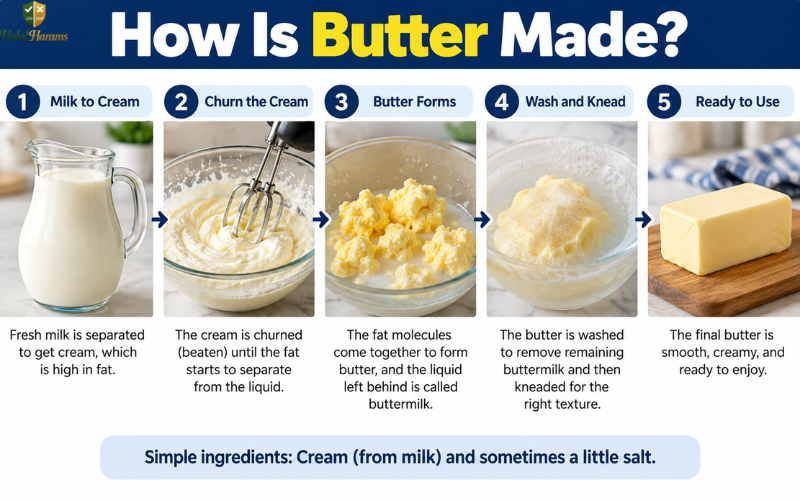
Butter production begins with cream obtained from milk. The cream is churned until fat globules combine and separate from the liquid.
The process generally includes:
| Step | Description |
|---|---|
| Milk Collection | Fresh milk is gathered from dairy animals |
| Cream Separation | Cream is separated from milk |
| Churning | Cream is agitated to form butterfat |
| Washing | Butterfat is cleaned and refined |
| Salting | Salt may be added for flavor |
| Packaging | Butter is packed for sale |
In its simplest form, butter contains only cream and sometimes salt.
Is Butter Halal?
Yes, plain butter is generally considered halal.
Since butter is derived from milk, and milk from halal animals such as cows, goats, and sheep is permissible in Islam, traditional butter is usually halal.
Most Islamic scholars agree that ordinary butter made solely from milk or cream does not present any halal concerns.
However, Muslims should still examine ingredient labels because some commercial butter products contain additional ingredients that may affect halal status.
Related Post:Is Mirin Halal? Complete Guide for Muslim(2026)
Quranic Perspective on Dairy Products
The Quran highlights milk as one of the blessings provided by Allah for human consumption.
Milk from permissible animals is considered lawful and wholesome.
Since butter originates from milk, it generally falls under the category of halal foods unless additional non-halal ingredients are introduced during production.
This serves as the foundation for the widespread acceptance of butter among Muslims around the world.
Why Butter Is Generally Considered Halal
Several factors contribute to butter’s halal status.
| Reason | Explanation |
|---|---|
| Made from milk | Milk from halal animals is permissible |
| Natural dairy product | Traditional butter contains minimal ingredients |
| No intoxicants | Butter does not contain alcohol naturally |
| Widely accepted by scholars | Most scholars consider plain butter halal |
| Common food ingredient | Used globally without major halal concerns |
These factors make standard butter one of the more straightforward dairy products from an Islamic dietary perspective.
Types of Butter and Their Halal Status
Not all butter products are identical. Different varieties may contain additional ingredients.
| Butter Type | Halal Status |
|---|---|
| Unsalted Butter | Generally halal |
| Salted Butter | Generally halal |
| Cultured Butter | Usually halal, verify cultures if necessary |
| Organic Butter | Generally halal |
| Flavored Butter | Requires ingredient review |
| Garlic Butter | Usually halal, check additives |
| Herb Butter | Usually halal, verify ingredients |
While basic butter is generally permissible, specialty products may require closer inspection.
Is Salted Butter Halal?
Salted butter is typically halal.
The primary ingredients are:
- Cream
- Salt
Since both ingredients are generally permissible, salted butter presents few halal concerns.
Muslims can usually consume salted butter without hesitation unless additional flavorings or additives have been included.
Is Unsalted Butter Halal?
Unsalted butter is often the purest form of commercial butter.
Its ingredients usually consist of:
- Cream
- Sometimes natural cultures
Because of its simplicity, unsalted butter is generally considered halal by Islamic scholars.
Is Cultured Butter Halal?
Cultured butter is produced by adding bacterial cultures to cream before churning.
These cultures create a richer flavor and slightly tangy taste.
In most cases, cultured butter remains halal. However, consumers who wish to exercise extra caution may verify the source of bacterial cultures and processing aids used during manufacturing.
Most mainstream cultured butter products are considered permissible.
Is Organic Butter Halal?
Organic certification relates to farming practices rather than halal compliance.
Organic butter is generally halal if:
- It is made from milk or cream.
- No haram additives are included.
- Flavorings and preservatives are halal.
Organic status alone does not guarantee halal certification, but the butter itself is often permissible.
Ingredients That May Affect Butter’s Halal Status
Although plain butter is halal, certain added ingredients may create concerns.
Consumers should review labels carefully when purchasing specialty butter products.
Common Ingredients to Check
| Ingredient | Halal Concern |
|---|---|
| Alcohol-Based Flavoring | Significant concern |
| Animal-Derived Emulsifiers | Source should be verified |
| Gelatin Additives | Source must be checked |
| Enzymes | Origin may vary |
| Artificial Flavorings | Verification recommended |
Most traditional butter products do not contain these ingredients, but flavored varieties occasionally do.
Related Post: Is Cheese Halal? A Complete Guide for Muslims
Is Flavored Butter Halal?
Flavored butter can be halal, but ingredient verification is necessary.
Examples include:
- Garlic butter
- Herb butter
- Honey butter
- Truffle butter
- Cinnamon butter
The butter itself may be halal, but flavoring agents, extracts, or additives should be examined.
For example, some flavor extracts may use alcohol during processing.
Is Garlic Butter Halal?
Garlic butter is usually halal because it commonly contains:
- Butter
- Garlic
- Herbs
- Salt
However, packaged garlic butter products should still be reviewed for preservatives and flavor enhancers.
Most homemade garlic butter is halal.
Is Whipped Butter Halal?
Whipped butter is regular butter that has been aerated to create a lighter texture.
Additional ingredients may include:
- Cream
- Salt
- Air
Whipped butter is generally halal as long as no questionable additives are included.
Is Margarine Halal Like Butter?
Many people confuse butter with margarine, but they are different products.
Butter is dairy-based, while margarine is typically made from vegetable oils.
| Feature | Butter | Margarine |
|---|---|---|
| Source | Dairy cream | Vegetable oils |
| Processing | Minimal | More processed |
| Halal Concerns | Usually low | Ingredient review needed |
| Dairy Content | Yes | Often no |
| Flavor | Rich and creamy | Varies by brand |
Margarine may contain emulsifiers, flavorings, or additives requiring halal verification.
Related Post: Is Bonchon Halal? Complete Guide for Muslims(2026)
Can Butter Contain Alcohol?
Plain butter does not naturally contain alcohol.
However, some specialty products may include flavorings extracted using alcohol-based methods.
Examples may include:
- Vanilla-flavored butter spreads
- Specialty dessert butters
- Gourmet flavored products
Consumers should read ingredient labels carefully when purchasing flavored varieties.
Is Butter Used in Halal Foods?
Butter is widely used in halal cuisine across the world.
Common halal dishes containing butter include:
- Naan bread
- Butter rice
- Pastries
- Cakes
- Traditional desserts
- Vegetable dishes
- Grilled foods
Because butter is generally halal, it is frequently incorporated into Muslim cooking traditions.
Is Butter From Cow’s Milk Halal?
Yes, butter made from cow’s milk is halal.
Cows are among the animals whose milk is permissible for Muslims to consume.
As long as the butter remains free from non-halal additives, it is considered lawful.
Is Butter From Goat’s Milk Halal?
Goat milk and products derived from it are also halal.
Butter produced from goat’s milk follows the same general ruling as cow’s milk butter and is typically permissible.
Is Butter From Sheep’s Milk Halal?
Sheep are halal animals, and their milk is lawful for consumption.
Butter made from sheep’s milk is therefore generally halal unless prohibited ingredients are added.
Does Butter Require Halal Certification?
Basic butter does not always require halal certification because its ingredients are often simple and naturally halal.
However, halal certification offers additional reassurance by confirming that:
- Ingredients have been reviewed.
- Manufacturing processes meet halal standards.
- Cross-contamination risks are minimized.
Many Muslims prefer certified products for added confidence.
Cross-Contamination Concerns
Cross-contamination can occur during manufacturing if halal and non-halal products are processed using the same equipment.
Potential concerns include:
- Shared production lines
- Shared storage facilities
- Shared packaging equipment
Reputable manufacturers usually implement strict hygiene and separation procedures, but halal certification can provide further assurance.
How to Identify Halal Butter
Consumers can follow several simple steps.
Read Ingredient Labels
Look for:
- Cream
- Milk
- Salt
These ingredients are generally halal.
Check for Halal Certification
A recognized halal certification logo can provide added confidence.
Review Specialty Ingredients
Pay close attention to:
- Flavorings
- Preservatives
- Emulsifiers
- Enzymes
Contact the Manufacturer
If ingredient sources are unclear, contacting the manufacturer may help clarify concerns.
Health Benefits of Butter
Butter is valued not only for its flavor but also for its nutritional content.
| Nutrient | Benefit |
|---|---|
| Vitamin A | Supports vision and immunity |
| Vitamin D | Supports bone health |
| Vitamin K2 | Supports calcium metabolism |
| Healthy Fats | Provides energy |
| Butyrate | May support digestive health |
While butter should be consumed in moderation, it can be part of a balanced diet.
Common Misconceptions About Butter
All Butter Is Automatically Halal
Most butter is halal, but flavored products may contain questionable ingredients.
Butter and Margarine Are the Same
They are different products with different ingredients and manufacturing processes.
Organic Means Halal
Organic certification does not automatically guarantee halal compliance.
Halal Certification Is Unnecessary
Although basic butter is usually halal, certification provides additional assurance regarding ingredients and production methods.
Frequently Asked Questions
Is butter halal
Yes, plain butter made from milk or cream is generally considered halal by Islamic scholars.
Is salted butter halal
Yes, salted butter is usually halal because it typically contains only cream and salt.
Is unsalted butter halal
Yes, unsalted butter is generally halal and often contains only cream.
Is garlic butter halal
Most garlic butter products are halal, but packaged versions should be checked for additional ingredients.
Does butter contain alcohol
Traditional butter does not naturally contain alcohol. Specialty flavored products may require ingredient verification.
Is cultured butter halal
Cultured butter is generally halal, though some consumers may wish to verify culture sources.
Does butter need halal certification
Not necessarily, but halal certification provides additional confidence regarding ingredients and production practices.
Can Muslims eat butter every day
Yes, butter is halal for Muslims when made from permissible ingredients and consumed as part of a balanced diet.
Is butter healthier than margarine
Both have different nutritional profiles. Health considerations depend on ingredients, dietary needs, and consumption levels.
Final Remarks
For most Muslims, plain butter made from milk or cream is halal as long as it does not contain any haram ingredients. Simple butter usually has just cream, with salt added in salted varieties. The main thing to check is the ingredient list, especially with flavored, processed, or specialty butter.
If a butter product contains unfamiliar additives, flavorings, or ingredients derived from animals, checking their source can help remove doubt. A halal-certified butter is another simple option when you want extra assurance.
Islam allows Muslims to enjoy many ordinary foods, while asking them to avoid clearly prohibited substances. So there is no need to avoid butter simply because you are unsure about the word “butter.” Check what is actually inside the product and choose a variety that fits your halal dietary requirements.
