
Parmesan cheese adds a rich, savory flavor to pasta, pizza, salads, and many other dishes, but Muslims often have one important question before eating it: Is Parmesan cheese halal or haram? The answer depends largely on how the cheese is made and, especially, where its rennet comes from.
Traditional Parmesan cheese is commonly made with animal-derived rennet, an enzyme used to separate milk into curds and whey. If that enzyme comes from an animal that was not slaughtered according to Islamic requirements, some scholars consider the cheese impermissible, while others permit it under particular scholarly interpretations.
The issue also differs between traditional Parmigiano Reggiano made in Italy and Parmesan-style cheeses sold in American supermarkets. Understanding the ingredients, manufacturing process, and differences among Islamic legal schools can help you make a more informed choice.
In this guide, we will explain when Parmesan cheese is halal, when it may be haram, and what Muslim consumers should check before buying it.
Is Parmesan Cheese Halal or Haram?
Verdict: Traditional Parmesan cheese is not automatically halal. Its ruling depends on the source of its rennet and the scholarly opinion you follow.
Authentic Parmigiano Reggiano traditionally uses animal rennet, generally obtained from the stomach lining of young ruminants. The animal’s species, slaughter status, and the legal interpretation of its processed enzymes can affect the ruling.
| Parmesan type | General halal assessment |
|---|---|
| Traditional Parmigiano Reggiano | Requires checking the rennet source and applicable ruling |
| Parmesan made with microbial enzymes | Generally halal if other ingredients are permissible |
| Parmesan labeled halal-certified | Usually the clearest option, provided certification is trustworthy |
| Parmesan with unspecified rennet | Status is uncertain until the source is confirmed |
A cheese’s name alone does not establish its halal status. Check the ingredients, manufacturer information, and any reliable halal certification before deciding.
Related Post: Is Pepperoni Halal or Haram? What Muslims Need to Know
Why Can Parmesan Cheese Be Haram?
The main concern is rennet, not the milk itself. Milk from permissible animals is generally halal, but the enzyme used to make cheese can raise questions about its origin.
What is animal rennet?
Rennet is a group of enzymes that helps milk coagulate. It is traditionally extracted from the stomach lining of a young calf, although rennet can also come from other animals or be produced through microbial and fermentation-based methods.
Animal-derived rennet creates a question of Islamic slaughter requirements. If it comes from an animal that was not slaughtered according to Islamic law, scholars differ on whether the resulting enzyme and cheese are permissible.
Does Parmesan contain pork?
Traditional Parmesan is not ordinarily made with pork rennet. Its traditional production uses rennet from a young ruminant, generally a calf.
However, consumers should not assume that every Parmesan-style product has the same ingredients. Check the package or contact the manufacturer if the rennet source is not specified.
What Makes Traditional Parmesan Different?
Traditional Parmigiano Reggiano is a protected Italian cheese with specific production rules. Its ingredients and manufacturing process differ from those of some generic Parmesan-style products.
Authentic Parmigiano Reggiano is traditionally made with cow’s milk, salt, and calf rennet. It is aged for an extended period, developing its familiar firm texture and concentrated flavor.
| Feature | Traditional Parmigiano Reggiano |
|---|---|
| Milk | Cow’s milk |
| Traditional coagulant | Calf rennet |
| Aging | At least 12 months |
| Main concern for Muslims | Source and religious status of the rennet |
| Flavor | Nutty, savory, and concentrated |
The traditional use of calf rennet does not, by itself, prove that the cheese is haram. The animal’s slaughter status and the fiqh position on rennet must also be considered.
American supermarket products marketed as Parmesan may use different enzyme preparations. Some use microbial enzymes, which can make it easier to identify a suitable option.
Related Post: Is Jello Halal? Complete Guide For Muslims(2026)
Is Animal Rennet Halal in Islam?
There is a genuine difference of scholarly opinion on animal rennet from animals that were not slaughtered according to Islamic requirements.
Some scholars permit cheese made with such rennet, relying on interpretations of early Islamic practice and the view that rennet is a substance distinct from the animal’s meat. Other scholars take a stricter position, especially when the rennet comes from an animal that was not slaughtered Islamically.
These differences should be understood as established questions in Islamic jurisprudence rather than treated as proof that one ruling applies universally to every Muslim.
What about the four madhabs?
The Hanafi, Maliki, Shafi’i, and Hanbali legal traditions contain discussions of rennet, its source, and the status of cheese made with it. Details and conditions can differ within a school, and later scholars may distinguish between rennet from a permissible animal, an improperly slaughtered animal, and an animal that is itself prohibited.
| Legal consideration | Why it matters |
|---|---|
| Animal species | Rennet from a permissible animal differs from rennet from a prohibited animal |
| Slaughter method | Some rulings require lawful slaughter for the source animal |
| Nature of the substance | Scholars differ on how the processing of rennet affects its status |
| School and scholarly guidance | The applicable ruling may depend on the interpretation followed |
It would be misleading to claim that all four schools give one identical ruling on every type of rennet. If you follow a particular madhhab, consult a qualified scholar familiar with its position on cheese enzymes.
Is Microbial Rennet Halal?
Microbial rennet is generally considered halal when it is produced from permissible sources and the rest of the cheese’s ingredients and processing meet Islamic requirements.
Unlike traditional animal rennet, microbial rennet is produced using microorganisms rather than being directly extracted from an animal’s stomach. It is widely used in modern cheese production.
Another option is fermentation-produced chymosin, an enzyme made through fermentation technology. Its production method differs from traditional calf rennet, although manufacturers should still be checked for the specific enzyme and processing details.
| Enzyme type | What consumers should know |
|---|---|
| Animal rennet | Verify the animal source and slaughter status |
| Microbial rennet | Generally suitable if the production inputs are permissible |
| Fermentation-produced chymosin | Often a practical alternative; verify certification and production details |
| Unspecified enzymes | Ask the manufacturer before treating the cheese as halal |
The words microbial enzymes or vegetarian enzymes on a label can be useful clues. A reliable halal certification offers additional assurance about ingredients and production.
Related Post: Is Whey Halal? A Muslim’s Guide to Whey Protein
How to Check If Parmesan Cheese Is Halal?
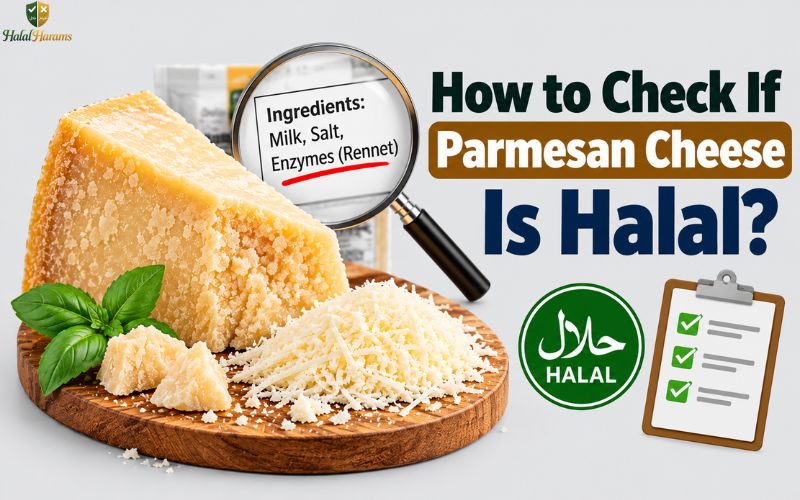
You do not need to guess every time you shop. A few practical checks can help you choose Parmesan that fits your dietary standards.
Read the ingredient label
Look for terms such as animal rennet, microbial enzymes, vegetarian enzymes, or enzymes. An ingredient list may not reveal the precise source, so an unspecified enzyme should not automatically be treated as either halal or haram.
Look for halal certification
A trustworthy halal certification can provide reassurance that the product’s ingredients and production process have been assessed. Check that the certification applies to the exact product, not merely to the manufacturer or another item in its range.
Contact the manufacturer
If the label only says “enzymes,” ask whether they are animal-derived, microbial, or fermentation-produced. If animal rennet is used, ask about the animal species and slaughter requirements where relevant.
Consider your scholarly guidance
If the source cannot be confirmed, you can choose a clearly suitable alternative while seeking guidance from a scholar whose rulings you trust. This is a practical way to avoid unnecessary uncertainty.
Is Kraft Parmesan Cheese Halal?
Kraft Parmesan products should not be assumed halal or haram based on the brand name alone. Formulations can differ by product and may change over time.
Check the ingredient label on your particular package and look for halal certification. If the source of the enzymes is not disclosed, contact the manufacturer for clarification.
For Muslims who require certainty about animal-derived ingredients, a product with clearly identified microbial enzymes or reliable halal certification may be a more straightforward choice.
Is Parmesan Cheese at Italian Restaurants Halal?
Parmesan served at a restaurant presents the same rennet question as packaged cheese, but the source can be harder to identify. A restaurant may use imported Parmigiano Reggiano, a domestic Parmesan-style cheese, or a blend of cheeses.
Ask the staff which cheese they use and whether the manufacturer provides information about the enzymes. If the restaurant cannot confirm the source, the decision will depend on your level of caution and the scholarly ruling you follow.
Also remember that the complete dish matters. Pasta sauces, meat toppings, broths, and other ingredients may raise separate halal concerns even if the cheese itself is suitable.
Related Post: Is Glycerin Halal? Everything Muslims Need to Know
What Does the Quran Say About Cheese and Rennet?
The Quran does not name Parmesan cheese or modern cheese-making enzymes. Instead, Muslims apply general dietary principles to new foods and manufacturing methods.
Allah says in Surah Al-Ma’idah 5:3 that certain categories of food, including carrion and pork, are prohibited. Surah Al-Baqarah 2:168 also instructs humanity to eat what is lawful and good.
These principles guide Islamic dietary rulings, but applying them to rennet requires understanding the substance’s origin and the relevant scholarly interpretation. The Quranic prohibition of pork, for example, does not establish that every cheese containing an unspecified enzyme is made with pork.
The discussion of rennet is therefore a matter of fiqh and ingredient verification, not simply a question of whether cheese is mentioned by name in scripture.
Common Mistakes Muslims Make When Buying Parmesan
Several assumptions can lead to confusion when checking Parmesan cheese.
- Assuming all cheese is halal: Cheese may contain animal-derived enzymes whose status needs checking.
- Assuming all Parmesan contains pork: Traditional Parmesan uses calf rennet, not ordinarily pork rennet.
- Treating “vegetarian” and “halal-certified” as identical: Vegetarian enzymes can be helpful, but certification covers a wider range of considerations.
- Assuming every imported product is the same: Recipes and manufacturing methods can vary between products.
- Ignoring the complete dish: Cheese is only one part of a meal, and other ingredients may need separate assessment.
A careful reading of the label and a reliable answer from the manufacturer can resolve many of these concerns.
Frequently Asked Questions
Can Muslims eat Parmesan cheese?
Yes, when its ingredients and production meet the halal requirements you follow. Traditional Parmesan often uses animal rennet, so check the source or choose a suitably certified product.
Is all Parmesan cheese haram?
No. Parmesan made with suitable microbial enzymes or otherwise meeting halal requirements can be permissible. Traditional animal rennet raises a scholarly question rather than making every Parmesan product automatically haram.
Does Parmesan cheese contain pork?
Traditional Parmigiano Reggiano is made with calf rennet, not ordinarily pork rennet. However, always check the ingredients of individual Parmesan-style products.
Is Parmesan cheese halal according to the Hanafi madhhab?
The ruling depends on the relevant Hanafi interpretation and the rennet’s source. Because scholars discuss animal rennet under specific conditions, consult a qualified Hanafi scholar for a personal ruling.
Is vegetarian Parmesan halal?
Parmesan made with microbial or suitable fermentation-produced enzymes is generally a practical halal option, provided all other ingredients and production processes are permissible. Vegetarian labeling alone is not complete halal certification.
What is the safest Parmesan cheese for Muslims to buy?
Choose Parmesan with reliable halal certification or clearly identified microbial enzymes and otherwise permissible ingredients. If the enzyme source is unclear, ask the manufacturer or select a verified alternative.
Related Post: Is Beef Gelatin Halal? A Clear Islamic Guide to Bovine Gelatin
Final Takeaway
Parmesan cheese can be halal, but traditional Parmesan requires closer attention because it is commonly made with calf rennet. Some scholars permit cheese made with certain forms of animal rennet even when the animal was not slaughtered Islamically, while others apply stricter conditions.
For a practical choice, look for reliable halal certification or Parmesan made with suitable microbial enzymes. If a product uses animal rennet and does not provide enough information, check with the manufacturer and follow qualified scholarly guidance rather than assuming the cheese is automatically permissible or prohibited.
Disclaimer: This article provides general educational information, not a personal fatwa. Consult a qualified local scholar or imam for guidance according to your madhhab and circumstances.
