
M&M’s are one of the most popular chocolate candies in the world. They are known for their colorful candy shells, smooth chocolate centers, and many different flavors. You can find M&M’s in supermarkets, convenience stores, and movie theaters across many countries. Since they are widely available, many Muslims ask an important question: Are M&M’s halal?
The answer is not the same for every type of M&M’s or every country. While many varieties do not contain pork gelatin, some ingredients, such as flavorings, food colorings, or dairy-based additives, may raise halal concerns. Recipes can also change depending on where the product is made, so the ingredient list may not be identical in every market. In addition, not all M&M’s products carry halal certification.
For this reason, it is important to check the ingredients and any halal certification before buying. In this guide, you will learn what M&M’s are made of, which ingredients Muslims should pay attention to, and whether different M&M’s varieties are generally considered halal. By the end, you will have a clear understanding of how to choose M&M’s that fit your Islamic dietary requirements with confidence.
The Short Answer
M&M’s are generally considered halal by many Muslims, but they are not officially halal-certified in most regions and may fall into a doubtful category.
What Are M&M’s?
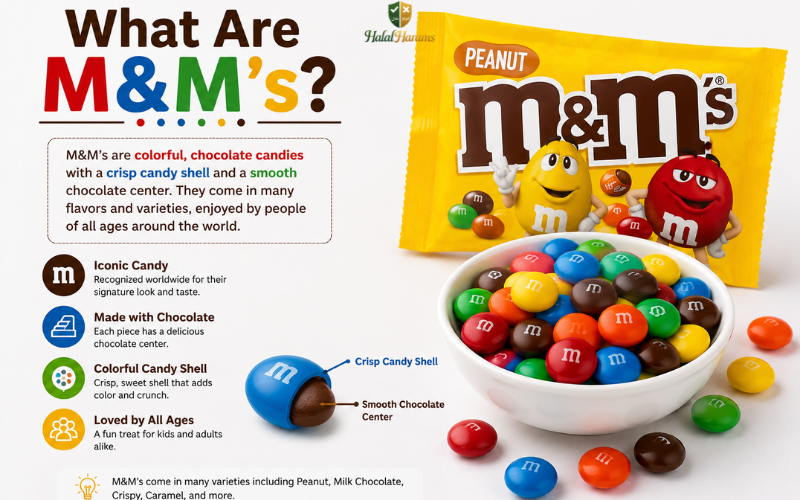
M&M’s are small, round chocolates coated with a colorful candy shell. They are produced by Mars Incorporated and come in many varieties, including:
- Milk chocolate
- Peanut
- Crispy
- Caramel
- Almond
- Peanut butter
Each variation may have slightly different ingredients, which can affect their halal status.
Ingredients in M&M’s
To determine whether M&M’s are halal, we must carefully examine their ingredients.
Common Ingredients in M&M’s
| Ingredient | Source Type | Halal Status |
| Sugar | Plant-based | ✅ Halal |
| Cocoa / Chocolate | Plant-based | ✅ Halal |
| Milk Powder | Animal (dairy) | ✅ Halal |
| Cornstarch | Plant-based | ✅ Halal |
| Artificial Colors | Synthetic | ⚠️ Usually Halal |
| Flavorings | Mixed | ⚠️ Check |
| Emulsifiers (E322) | Soy/Lecithin | ✅ Halal |
| Glazing Agents | Mixed | ⚠️ Check |
👉 Most ingredients appear halal, but some require closer attention.
Related Post: Is Chocolate Liquor Halal? Complete Guide for MUslims(2026)
Key Ingredients That Raise Concerns
Even though many ingredients are safe, a few components make the halal ruling less straightforward.
1. Flavorings
Flavorings may:
- Use alcohol as a solvent
- Be derived from unknown sources
This is one of the biggest uncertainties in processed foods.
2. Glazing Agents (Shell Coating)
The shiny coating on M&M’s may include:
- Shellac (E904), derived from insects
Scholars differ on whether shellac is halal.
3. Artificial Colors
Most are synthetic, but:Some may have unclear processing methods
Generally considered permissible, but still worth noting.
4. Cross-Contamination
Factories may also produce:
- Non-halal products
- Items containing gelatin
This raises the possibility of cross-contact.
Do M&M’s Contain Gelatin?
👉 Most standard M&M’s do NOT contain gelatin.
This is a positive point, as gelatin is one of the most common haram ingredients in sweets.
However, some special or limited-edition products may vary, so always check labels.
Why M&M’s Are Often Considered Halal
1. No Gelatin
Most varieties do not contain gelatin, which removes a major concern.
2. Mostly Plant-Based Ingredients
The core ingredients like cocoa, sugar, and starch are halal.
3. No Clear Haram Ingredients
There are no obvious haram ingredients listed in standard versions.
Why Some Muslims Avoid M&M’s
Despite the positive aspects, some Muslims choose to avoid them due to:
Lack of Halal Certification
- No official verification
- No guarantee of full compliance
Doubtful Ingredients
- Flavorings
- Glazing agents like shellac
Strict Dietary Approach
Some people prefer:
- Only certified halal products
- Avoiding anything doubtful (mashbooh)
Are M&M’s Halal in Different Countries?
The halal status may vary depending on where they are produced.
Regional Differences
| Region | Halal Status |
| USA | ⚠️ Not certified |
| UK | ⚠️ Some variations |
| Middle East | ✅ More likely halal-certified |
| Asia | ⚠️ Varies |
👉 Always check the packaging in your region.
Related Post: Are Marshmallows Halal
What Do Scholars Say?
Scholarly Opinions
| Opinion Type | View |
| Permissible by Default | Halal unless proven haram |
| Cautious Approach | Avoid doubtful ingredients |
| Strict Approach | Only halal-certified allowed |
Comparing M&M’s with Other Chocolates
Comparison Table
| Product Type | Risk Level | Halal Status |
| Plain Chocolate | Low | ✅ Usually Halal |
| M&M’s | Medium | ⚠️ Doubtful |
| Gelatin Candy | High | ❌ Haram (unless halal-certified) |
| Halal-Certified Candy | None | ✅ Halal |
How to Check If M&M’s Are Halal
1. Read the Ingredients
Check for:
- Alcohol
- Gelatin
- Unknown additives
2. Check Certification
Look for halal logos on packaging.
3. Contact the Manufacturer
Ask about:
- Source of flavorings
- Use of alcohol
4. Choose Region-Specific Products
Some countries offer halal-certified versions.
Halal Alternatives to M&M’s
If you want to avoid doubt, consider:
Alternatives
| Option | Benefit |
| Halal-certified chocolates | Fully verified |
| Vegan chocolates | Fewer animal concerns |
| Homemade treats | Full control |
Why This Topic Matters
Understanding whether M&M’s are halal is important because:
- They are widely consumed
- Ingredients can be hidden
- Small doubts can affect religious practice
Islam encourages:
- Eating halal
- Avoiding doubtful matters
Common Misconceptions
“All chocolate is halal”
Not always—additives matter.
“No gelatin means halal”
Not necessarily—other ingredients can still be questionable.
“Western brands are always haram”
Incorrect—many are permissible or close to halal.
If you found this guide helpful, explore these related Halal and Harams articles for more answers to common food and ingredient questions.
- Is Swedish Fish Halal Or Haram?(2026)
- What Is Halal Food? Complete Guide For Muslims(2026)
- Is Dave’s Hot Chicken Halal? Complete Guide for Muslims(2026)
- Is Bovine Gelatin Halal? Complete Guide for Muslims(2026)
- Is Boba Halal? Complete Guide for Muslims(2026)
- Are M&M’s Halal? Complete Guide For Muslims(2026)
FAQs
Are M&M’s halal?
M&M’s are generally considered halal by many Muslims, but they are not officially certified and may be considered doubtful.
Do M&M’s contain gelatin?
No, most standard M&M’s do not contain gelatin.
Do M&M’s contain alcohol?
There is no clear evidence, but flavorings may use alcohol carriers.
What is shellac in M&M’s?
Shellac is a glazing agent derived from insects, and scholars differ on its permissibility.
Can Muslims eat M&M’s?
Many Muslims do, but some prefer to avoid them due to uncertainty.
What is the safest option?
Halal-certified chocolate is always the safest choice.
Final Remarks
M&M’s are a widely enjoyed chocolate that, at first glance, appear to be halal due to the absence of gelatin and the use of mostly plant-based ingredients. However, factors such as flavorings, glazing agents, and lack of halal certification introduce some uncertainty.
For many Muslims, M&M’s fall into a doubtful (mashbooh) category rather than being clearly halal or haram. This means the decision ultimately depends on your personal level of caution and understanding.
If you prefer certainty, it is best to choose halal-certified alternatives. But if you are comfortable relying on the absence of clearly haram ingredients, you may consider them permissible.
The key is to stay informed, read labels carefully, and make choices that align with your values and beliefs.
