
Rice wine is generally haram in Islam when it is an alcoholic drink that can intoxicate, but what about rice wine used in cooking? Many Muslims encounter this ingredient in Chinese stir-fries, Japanese sauces, marinades, soups, and restaurant meals without knowing whether it is permissible. The answer depends on the type of product, its ingredients, and how it is made. Traditional rice wine contains alcohol and falls under the Islamic prohibition of intoxicants. However, rice vinegar and alcohol-free rice wine substitutes are different products and may be halal when their ingredients meet Islamic requirements.
Understanding these differences can help you make better decisions when shopping, cooking at home, or ordering Asian food. A product labelled “cooking wine” is not automatically halal, and heating alcoholic rice wine does not guarantee that all its alcohol disappears. In this guide, we will examine the Islamic ruling, relevant Quranic verses and hadith, differences between rice wine and rice vinegar, the status of Shaoxing wine and mirin, and practical alternatives Muslims can use in everyday cooking.
Is Rice Wine Halal or Haram in Islam?
Verdict: Traditional alcoholic rice wine is haram according to the general Islamic ruling on intoxicating beverages. Its source does not change the ruling. An intoxicating drink made from rice is treated according to the same fundamental prohibition that applies to intoxicating drinks made from grapes or other ingredients.
However, the name on a package is not enough to determine the status of every product. Rice vinegar, alcohol-free rice seasoning, and traditional alcoholic rice wine are not necessarily the same thing.
| Product | General halal status | Reason |
|---|---|---|
| Traditional alcoholic rice wine | Haram | It is an alcoholic beverage that can intoxicate |
| Shaoxing rice wine | Generally haram | Traditional varieties contain alcohol |
| Traditional mirin | Generally haram | It contains alcohol and is used as a seasoning |
| Rice vinegar | Generally halal | It is vinegar rather than an intoxicating beverage |
| Alcohol-free rice seasoning | Potentially halal | Ingredients and manufacturing must be suitable |
| Halal-certified rice wine substitute | Generally permissible | Certification and ingredients should be verified |
These are general guidelines, not a certification of every product. If a manufacturer uses an unusual process or the label is unclear, the specific product may require further investigation.
What Is Rice Wine Made Of?
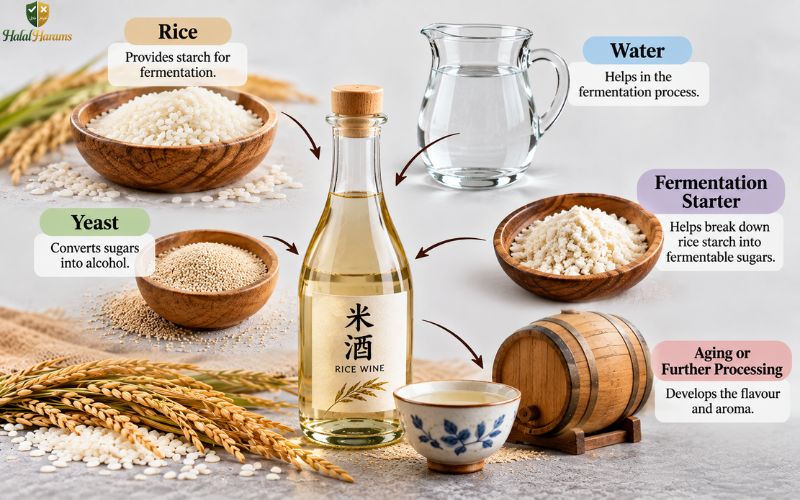
Rice wine is produced by fermenting rice. The process usually involves rice, water, yeast, and a fermentation starter containing microorganisms or enzymes that help convert rice starch into sugars. Yeast then converts fermentable sugars into alcohol.
Different varieties have different flavours, production methods, and alcohol levels. Some are made primarily for drinking, while others are commonly used in food preparation.
| Component | Purpose |
|---|---|
| Rice | Supplies starch for fermentation |
| Water | Supports the fermentation process |
| Yeast | Converts sugars into alcohol |
| Fermentation starter | Helps break down starch into sugars |
| Aging or further processing | Develops flavour and aroma |
Rice itself is halal. The question is what happens during processing and what kind of product is produced.
Fermentation does not automatically make every food haram. Many ordinary foods undergo fermentation without becoming intoxicating beverages. The Islamic concern here is the nature of the resulting product, especially when it is an alcoholic drink intended for consumption.
Related Post: Is Nando’s Halal? What Muslims Should Know Before Ordering
What Does the Quran Say About Rice Wine and Alcohol?
The Quran establishes a clear prohibition of intoxicants. Although rice wine is not named specifically, the general guidance applies to intoxicating drinks regardless of the ingredient from which they are produced.
Allah says:
“O you who have believed, indeed, intoxicants, gambling, [sacrificing on] stone alters [to other than Allah], and divining arrows are but defilement from the work of Satan, so avoid it that you may be successful.”
Quran 5:90 — Sahih International translation
This verse instructs believers to avoid intoxicants. Traditional alcoholic rice wine falls under this principle when it is an intoxicating beverage.
The Prophet Muhammad ﷺ also said:
“Every intoxicant is khamr, and every khamr is haram.”
Source: Sahih Muslim
This hadith explains why the prohibition is not restricted to grape wine. An intoxicating drink does not become permissible simply because it is made from rice, barley, dates, or another substance.
A further prophetic principle states that whatever intoxicates in a large quantity is prohibited even in a small quantity. This teaching is reported in the hadith collections of Abu Dawud and al-Tirmidhi.
Is Rice Wine Haram Even When Used for Cooking?
Yes, traditional alcoholic rice wine should generally be avoided when it is deliberately added to food. Using an ingredient in a sauce or marinade instead of drinking it does not automatically change its Islamic status.
Rice wine is frequently used in Chinese cooking to improve the flavour of meat, seafood, vegetables, and sauces. It may also appear in recipes for noodles, soups, and braised dishes.
Consider these common situations:
| Situation | Practical Islamic guidance |
|---|---|
| Adding alcoholic rice wine to a stir-fry | Avoid it |
| Marinating chicken in traditional rice wine | Avoid it |
| Using a halal-certified, alcohol-free substitute | Generally permissible if its ingredients are halal |
| Preparing a sauce with ordinary rice vinegar | Generally permissible |
| Ordering food containing an unknown cooking sauce | Ask about the ingredients |
Some people believe that cooking makes alcoholic rice wine halal because the alcohol evaporates. This assumption is unreliable. Cooking can reduce alcohol, but the amount remaining depends on the cooking method, temperature, duration, and recipe.
There is also a difference between the scientific question of how much alcohol remains and the Islamic question of whether an intoxicating ingredient may deliberately be added to food. Both questions matter, and evaporation alone does not settle the religious ruling.
Related Post: Is Whey Halal? A Muslim’s Guide to Whey Protein
Does Cooking Rice Wine Remove All the Alcohol?
No. Heating alcoholic rice wine does not guarantee complete alcohol removal.
Alcohol evaporates under cooking conditions, but food does not instantly become alcohol-free when it reaches a particular temperature. Some alcohol may remain, depending on the preparation method.
| Cooking method | What may happen |
|---|---|
| Quick stir-frying | Some alcohol may remain |
| Briefly heating a sauce | Alcohol may decrease but is not guaranteed to disappear |
| Simmering for a longer period | More alcohol may evaporate, depending on conditions |
| Adding rice wine near the end | Less time is available for evaporation |
| Cooking in a covered pot | Evaporation and retention differ from an uncovered pot |
The exact amount remaining varies with the recipe and cooking conditions. It is therefore unwise to assume that a dish becomes permissible simply because it has been heated.
For everyday cooking, the straightforward option is to leave out alcoholic rice wine and use a suitable substitute from the beginning. This avoids uncertainty about both the ingredients and the cooking process.
Is Chinese Shaoxing Rice Wine Halal?
Traditional Shaoxing wine is a Chinese rice wine commonly used in stir-fries, marinades, braised dishes, and sauces. It provides a distinctive flavour that many recipes rely on.
Traditional alcoholic Shaoxing wine is generally considered haram. The fact that it is sold for cooking does not automatically make it permissible.
Some cooking wines contain added salt or other ingredients. Salt does not, by itself, change the ruling on an alcoholic beverage.
When buying Chinese seasonings, check the product label carefully. If the ingredients identify alcoholic rice wine, choose an appropriate alcohol-free alternative instead.
Restaurant meals also deserve attention. A dish may not taste alcoholic even when its sauce contains Shaoxing wine. If you want to avoid it, ask whether the kitchen can prepare your meal without alcoholic cooking wine.
Is Japanese Mirin Halal?
Mirin is a sweet Japanese seasoning used in teriyaki sauces, glazes, noodle dishes, and many other recipes. Traditional mirin contains alcohol, although products sold as mirin-style seasonings may have different formulations.
| Product type | General guidance |
|---|---|
| Traditional hon-mirin | Generally haram because it contains alcohol |
| Mirin-style seasoning containing alcohol | Check carefully and generally avoid it |
| Alcohol-free mirin-style seasoning | May be halal if all ingredients are permissible |
| Halal-certified mirin substitute | A practical choice when certification is reliable |
The word “mirin” alone does not establish halal status. Always check the ingredients and any halal certification.
If a recipe requires mirin, try a small amount of sugar mixed with water for sweetness. Depending on the dish, a little suitable stock or another permissible seasoning may help replace some of the flavour.
Is Rice Vinegar Halal?
Rice vinegar is generally halal when its ingredients are permissible and it is genuinely vinegar rather than alcoholic rice wine.
Rice vinegar and rice wine may be connected through fermentation, but they are different products. Vinegar production involves the conversion of alcohol into acetic acid through bacterial activity.
Classical Islamic scholarship generally recognises vinegar as permissible. However, scholars have discussed specific differences regarding vinegar deliberately made from wine, including the role of human intervention in the transformation process.
| Product | General ruling |
|---|---|
| Ordinary rice vinegar | Generally halal |
| Seasoned rice vinegar | Check added ingredients |
| Rice vinegar containing questionable additives | Investigate before use |
| Rice wine sold as a vinegar substitute | Verify the actual product |
| Vinegar made through an unusual wine-transformation process | May require a more specific scholarly ruling |
For ordinary shoppers, commercially produced rice vinegar with permissible ingredients is generally a suitable choice. Do not assume that rice wine and rice vinegar are interchangeable simply because both appear in Asian recipes.
Rrelated Post: Is Dr Pepper Halal? A Complete Guide for Muslim(2026)
Do the Four Sunni Madhhabs Have Different Views?
The Hanafi, Maliki, Shafi’i, and Hanbali schools agree on the general prohibition of intoxicating beverages. Some detailed rulings differ concerning particular substances, the transformation of wine into vinegar, and specific manufacturing circumstances.
| Madhhab | General principle relevant to rice wine |
|---|---|
| Hanafi | Intoxicating beverages are prohibited; detailed rulings distinguish between types and circumstances |
| Maliki | Intoxicants are prohibited; discussions of transformation and vinegar have specific details |
| Shafi’i | Intoxicating drinks are prohibited; wine transformed into vinegar is addressed under particular conditions |
| Hanbali | Intoxicating drinks are prohibited; detailed rulings address vinegar and transformation |
These summaries are intentionally broad. They should not be treated as complete school-specific legal rulings.
For traditional rice wine that is an intoxicating alcoholic beverage, the general prohibition is clear. More complex questions may arise when a product has undergone a substantial chemical transformation, contains uncertain residues, or is manufactured through an unusual industrial process.
In such cases, the product’s actual composition and manufacturing details should be presented to a qualified scholar rather than assuming that every product with a similar name has the same ruling.
What Are the Best Halal Substitutes for Rice Wine?
You can prepare many Asian dishes without alcoholic rice wine. The best replacement depends on whether the original ingredient contributes sweetness, acidity, moisture, or depth of flavour.
| Halal alternative | Suitable use | How to use it |
|---|---|---|
| Water with a little sugar | General cooking | Replaces some moisture and sweetness |
| Rice vinegar with sugar | Sauces and marinades | Adds acidity and a mild sweet note |
| Apple juice | Sweet marinades and glazes | Provides sweetness and fruit flavour |
| Halal chicken or vegetable stock | Soups and savoury dishes | Adds depth and moisture |
| Alcohol-free mirin-style seasoning | Japanese recipes | Follow the product instructions |
| A little lemon juice mixed with water | Bright sauces and marinades | Adds acidity; use sparingly |
Do not replace every recipe’s rice wine with vinegar in equal quantities. Vinegar is more acidic, so too much may make a sauce overly sharp. Start with a small amount and adjust according to taste.
When buying prepared substitutes, check the ingredients. A product marketed as an alternative is not automatically halal unless its composition meets Islamic requirements.
Related Post: Is Mirin Halal? Complete Guide for Muslim(2026)
How Can You Check Whether Rice Wine Is Halal?
Reading the label is the first practical step. Product names and attractive packaging do not establish halal status.
Use this checklist when shopping or eating out:
- Check the ingredients: Look for rice wine, alcoholic cooking wine, mirin, and other alcohol-containing ingredients.
- Verify halal certification: Check that the certification applies to the exact product.
- Distinguish similar names: Rice vinegar is not the same as rice wine.
- Ask restaurants directly: Find out whether sauces, marinades, or cooking seasonings contain alcoholic rice wine.
- Contact the manufacturer: If the label is unclear, request information about alcohol content and the production process.
- Choose a clear alternative: When you cannot verify the product, select a suitable ingredient whose status is clearer.
These steps are especially useful when shopping for imported products because ingredient names and formulations can vary by market.
Frequently Asked Questions About Rice Wine
Is rice wine halal or haram?
Traditional alcoholic rice wine is generally haram because it is an intoxicating beverage. Alcohol-free alternatives require a separate assessment of their ingredients and manufacturing process.
Can Muslims eat food cooked with rice wine?
Muslims should generally avoid food deliberately prepared with alcoholic rice wine. Cooking may reduce alcohol, but heating alone does not automatically establish that the food is permissible.
Is rice wine vinegar halal?
Ordinary rice vinegar is generally halal when its ingredients are permissible. Vinegar made through certain wine-transformation processes may require a more specific scholarly assessment.
Is Shaoxing cooking wine halal?
Traditional Shaoxing wine is alcoholic and generally considered haram. Its use in cooking does not automatically change the ruling, so choose a suitable alternative.
Is mirin halal for Muslims?
Traditional mirin contains alcohol and is generally considered impermissible. An alcohol-free, halal-certified mirin-style seasoning may be suitable if its ingredients meet Islamic requirements.
Does rice wine become halal after cooking?
Not automatically. Cooking may reduce the alcohol content, but some can remain, and the permissibility of adding an intoxicating alcoholic ingredient is a separate Islamic question.
Related Post: Is Balsamic Vinegar Halal? Shocking Guide for Muslims(2026)
Practical Takeaway: Should Muslims Avoid Rice Wine?
Is rice wine halal? For traditional alcoholic rice wine, the general Islamic ruling is no. Muslims should also generally avoid alcoholic Shaoxing wine and traditional mirin, even when these products are used in cooking rather than served as drinks.
Rice vinegar and alcohol-free seasonings may be suitable alternatives when their ingredients and production meet halal requirements. Check labels, ask restaurants about sauces and marinades, and use reliable halal certification where available.
When a product has an unusual formulation or unclear manufacturing process, do not assume it is permissible simply because it is labelled alcohol-free. Seek reliable product information and ask a qualified scholar when necessary.
Disclaimer: This article provides general Islamic information and is not an individual fatwa. For a specific product or an uncertain manufacturing process, consult a qualified local scholar or imam.
