
Rennet is halal in some cases, but its ruling depends on where it comes from, how it is processed, and which scholarly opinion a Muslim follows.
If you enjoy cheese, pizza, lasagna, or other dairy products, you may have wondered whether the rennet used to make them is permissible in Islam. The answer is not always as simple as checking whether a product contains milk, because traditional rennet can come from the stomach lining of a young animal, including calves and lambs. Some products use microbial or plant-based alternatives instead.
Understanding these differences can help you make informed food choices without unnecessary worry. In this guide, we will explain when rennet is halal or haram, how the major Islamic schools of thought approach animal-derived rennet, and what to check on cheese labels in the United States and elsewhere.
Is Rennet Halal or Haram?
Rennet is not automatically halal or haram. Its ruling depends mainly on its source and, in some cases, the method used to obtain it.
Microbial and plant-based rennet are generally considered halal when their ingredients and production processes do not involve other prohibited substances. Rennet obtained from an animal slaughtered according to Islamic requirements is also generally considered permissible.
The more debated case is rennet taken from an animal that was not slaughtered according to Islamic rules, particularly when it comes from a calf or lamb.
| Type of rennet | General halal assessment |
|---|---|
| Plant-based rennet | Generally halal |
| Microbial rennet | Generally halal, subject to ingredients and processing |
| Rennet from a properly halal-slaughtered animal | Generally halal |
| Rennet from an animal not slaughtered Islamically | Scholarly disagreement |
| Rennet from a pig | Haram |
These are general guidelines rather than a ruling on every product. The exact source and manufacturing process can matter.
Related Post: Is Parmesan Cheese Halal? Rennet, Ingredients & Islamic Ruling
What Is Rennet, and Why Is It Used in Cheese?
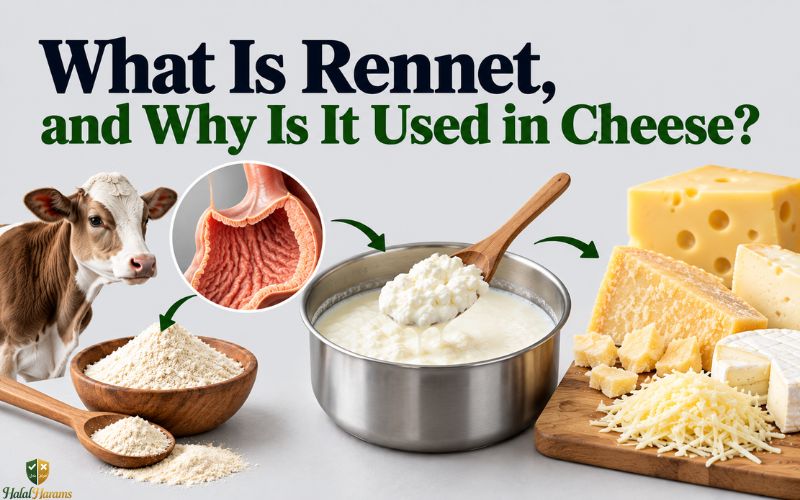
Rennet is a group of enzymes used to coagulate milk during cheese production. These enzymes cause milk proteins to form a solid curd, separating much of the liquid whey from the developing cheese.
Traditional animal rennet is commonly obtained from the stomach lining of young ruminants, such as calves. Modern cheesemakers can also use microbial enzymes, fermentation-produced enzymes, or plant-derived coagulants.
Rennet helps give different cheeses their characteristic texture, flavor, and structure. It is particularly common in many traditional hard and aged cheeses.
Is rennet the same as gelatin?
No. Rennet is an enzyme preparation used to coagulate milk, while gelatin is a protein obtained by processing collagen from animal tissues.
Both can raise halal questions when animal-derived, but their sources, functions, and religious rulings should not be treated as identical.
What Are the Different Types of Rennet?
Knowing the source of rennet is the first step toward understanding its halal status.
| Type | Source | Typical use |
|---|---|---|
| Animal rennet | Enzymes extracted from animal stomach tissue | Traditional cheeses |
| Microbial rennet | Enzymes produced by certain microorganisms | Many modern cheeses |
| Fermentation-produced chymosin | Chymosin produced through controlled fermentation | Cheddar and other cheeses |
| Plant-based coagulants | Enzymes or extracts from selected plants | Traditional and specialty cheeses |
Animal rennet
Animal rennet is the type most likely to raise questions about halal status. Its ruling may depend on the animal species, whether the animal was lawfully slaughtered, and the scholarly position followed.
Microbial rennet
Microbial rennet is produced using microorganisms rather than being directly extracted from an animal’s stomach. It is generally considered permissible, provided the culture medium, processing aids, and other ingredients do not introduce prohibited substances.
Fermentation-produced chymosin
Some manufacturers use fermentation technology to produce chymosin, an enzyme similar to the one naturally found in traditional rennet. The enzyme is produced by microorganisms under controlled conditions.
Its acceptability depends on the production process and the relevant halal certification requirements, not simply on the word “fermentation.”
Plant-based rennet
Certain plants contain enzymes that can coagulate milk. These coagulants are generally halal when they come from permissible sources and are processed without prohibited ingredients.
Related Post: Is Whey Halal? A Muslim’s Guide to Whey Protein
Is Animal Rennet Halal According to Islamic Scholars?
This is the central question behind many concerns about cheese. Islamic scholars have discussed whether rennet taken from an animal that was not slaughtered according to Islamic requirements is pure and permissible to consume.
There is a recognized difference of opinion among classical jurists. Some scholars permit certain forms of rennet from otherwise permissible animals even when the animal was not Islamically slaughtered. Other scholars consider such rennet impure or impermissible when it comes from an animal that was not slaughtered correctly.
The disagreement concerns the status of the rennet itself and whether it is affected by the animal’s death and the condition of the stomach tissue from which it is obtained.
What is the Hanafi view on rennet?
Hanafi jurists have generally allowed rennet from a permissible animal even if the animal was not slaughtered Islamically, provided the relevant conditions are met. The detailed reasoning concerns whether rennet is treated as a pure substance distinct from the surrounding tissue and blood.
This does not mean that every ingredient taken from an improperly slaughtered animal is permissible. Rennet has a specific legal discussion, and the ruling should not automatically be extended to other animal-derived ingredients.
What about the Maliki, Shafi’i, and Hanbali schools?
The schools do not have a single identical ruling across every circumstance. Many discussions in the Maliki, Shafi’i, and Hanbali traditions take a stricter approach to rennet obtained from an animal that died without valid Islamic slaughter, particularly when the source animal is treated as carrion.
There are also differences within the schools and among later scholars regarding the substance’s purity, its source, and the effect of processing.
| Scholarly approach | General position |
|---|---|
| Hanafi discussions | Often permit qualifying rennet from a permissible animal even without Islamic slaughter |
| Stricter juristic approaches | May prohibit rennet from an animal that was not Islamically slaughtered |
| Modern halal certification | Usually evaluates the source, manufacturing process, and applicable certification standard |
These are simplified descriptions of a detailed fiqh discussion. A person seeking to follow a particular madhhab should consult a qualified scholar familiar with that school’s relied-upon position.
What Does the Quran and Hadith Say About Rennet?
The Quran does not specifically name modern cheese rennet as a separate food ingredient. Instead, its general rules about lawful and unlawful food provide the foundation for scholars’ reasoning.
In Surah Al-Ma’idah (5:3), Allah identifies categories of prohibited food, including carrion and swine. Surah Al-Baqarah (2:173) also mentions carrion, blood, and pork among prohibited foods, with an exception for necessity under specified conditions.
These verses establish important principles, but they do not directly settle every question about an extracted enzyme. Scholars therefore examine the nature of rennet, its source, and whether the substance retains the ruling of the animal tissue from which it was taken.
The prophetic teachings about lawful and unlawful matters also encourage Muslims to approach doubtful issues carefully. That caution should be balanced with sound knowledge: a recognized scholarly disagreement does not mean that every cheese product is automatically doubtful or forbidden.
Is Cheese Made With Rennet Halal?
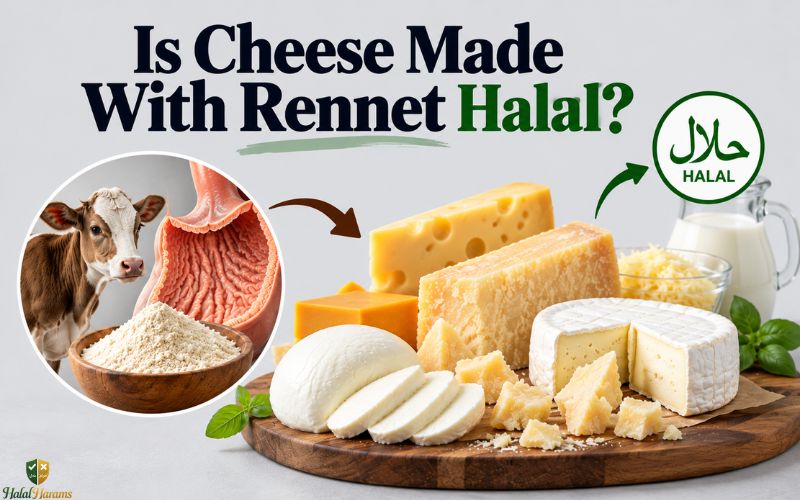
Cheese can be halal even when its production uses rennet. The key question is what kind of rennet was used and whether the product meets the standard you follow.
Cheeses made with microbial or qualifying fermentation-produced enzymes are often easier to assess than products made with unspecified animal rennet. However, the words “vegetarian” or “microbial” on their own do not guarantee that every other ingredient is halal.
| Cheese or product | What to check |
|---|---|
| Cheddar | Source of the coagulating enzyme |
| Parmesan | Whether animal rennet is used and its origin |
| Mozzarella | Enzyme source and any other animal-derived additives |
| Cream cheese | Full ingredient list and any processing aids |
| Processed cheese slices | Enzymes, emulsifying salts, and other ingredients |
| Cheese pizza | Cheese ingredients plus the meat and other toppings |
Is Parmesan cheese halal?
Traditional Parmesan, including Parmigiano Reggiano, is generally made using animal rennet. Muslims who follow a stricter view may avoid it unless its rennet source meets their requirements. Those following a recognized permissive opinion may assess it differently.
Do not assume that all Parmesan-style cheeses use the same ingredients. Check the particular product and the halal standard you follow.
Is mozzarella cheese halal?
Mozzarella can be made with different types of coagulants. Some varieties use microbial enzymes, while others may use animal rennet. Check the product label or ask the manufacturer when the source is not stated.
Related Post: Is HI-CHEW Halal? Complete Guide for Muslims(2026)
How Can You Tell Whether Rennet Is Halal on a Food Label?
Food labels do not always provide enough detail to determine the source of rennet. The term “enzymes” may refer to microbial or animal-derived enzymes, depending on the manufacturer and product.
Use these practical checks when shopping:
- Look for halal certification. Confirm that the certification applies to the specific product and, where relevant, its manufacturing facility.
- Check for microbial or plant-based rennet. These descriptions can help, although other ingredients and processing details may still matter.
- Ask about unspecified enzymes. Contact the manufacturer to find out whether the enzyme is animal-derived, microbial, or fermentation-produced.
- Consider your scholarly approach. If you follow a stricter ruling on animal rennet, an unspecified enzyme source may be a reason to choose another product.
- Do not rely on country of manufacture alone. Cheese produced in a Muslim-majority country is not automatically halal-certified, and cheese made elsewhere is not automatically haram.
A clear label is helpful, but a reliable certification or a direct manufacturer response may provide more information than the ingredient list alone.
Common Misconceptions
All animal rennet is haram
This is too broad. Rennet from a permissible animal slaughtered according to Islamic requirements is generally considered permissible. The disputed question mainly concerns certain other sources.
All cheese is haram unless it is halal-certified
This is also too broad. Many cheeses use microbial or plant-based coagulants, and some scholars permit qualifying animal rennet under specific conditions. Certification is useful, but the absence of a halal logo does not automatically establish that a product is forbidden.
Enzymes always come from animals
Enzymes can come from animals, plants, or microorganisms. The word “enzymes” alone does not identify the source, so further information may be needed.
Cooking makes haram rennet halal
Cooking does not automatically make a prohibited ingredient permissible. Heat treatment and cheese aging should not be assumed to change the religious ruling on the ingredient.
More Related Posts:
- Are Welch’s Fruit Snacks Halal? Complete(2026)
- Is Glycerin Halal? Everything Muslims Need to Know
- Is Beef Gelatin Halal? A Clear Islamic Guide to Bovine Gelatin
- Is Jello Halal? Complete Guide For Muslims(2026)
Frequently Asked Questions
Is rennet halal in Islam?
Rennet may be halal depending on its source and the scholarly opinion followed. Microbial and plant-based rennet are generally permissible when other ingredients and production conditions are halal.
Is animal rennet halal or haram?
Animal rennet from a properly halal-slaughtered permissible animal is generally halal. Rennet from an animal not slaughtered Islamically is a recognized area of scholarly disagreement.
Is microbial rennet halal?
Microbial rennet is generally considered halal because it is produced using microorganisms rather than directly extracted from an animal’s stomach, provided the production process is permissible.
Is Parmesan cheese halal?
Traditional Parmesan commonly uses animal rennet, so its acceptability depends on the source of the rennet and the scholarly standard followed. Check the specific product’s ingredients and certification.
Is cheese with unspecified enzymes halal?
Unspecified enzymes do not automatically make cheese haram. Ask the manufacturer about the enzyme source or choose a product with reliable halal certification if you need certainty.
Can Muslims eat cheese without halal certification?
Many cheeses may be permissible without formal certification, depending on their ingredients and manufacturing process. Muslims should investigate animal-derived ingredients when relevant to the ruling they follow.
Practical Takeaway
You do not need to avoid every cheese simply because rennet is used in its production. Start by checking whether the product uses microbial, plant-based, fermentation-produced, or animal-derived enzymes. If it contains animal rennet, determine whether its source meets the Islamic standard you follow, especially if you adhere to a stricter view.
For everyday shopping, halal-certified cheese or cheese made with clearly identified microbial or plant-based coagulants can make the decision easier. When the information is incomplete, asking the manufacturer is more useful than guessing from the brand name or country of origin.
Is rennet halal? The answer depends on its source, production details, and the recognized fiqh opinion you follow.
Disclaimer: This article provides general educational information, not a personal fatwa. Consult a qualified local scholar or imam for guidance according to your madhhab and circumstances.
