
Many food packages carry a kosher symbol, which can make Muslim shoppers wonder if the product is also halal. This leads to a common question: Is kosher halal? The two systems have some similarities, but they are not exactly the same.
Kosher food follows the dietary rules of Jewish law, while halal food follows the rules of Islamic law. Both systems have rules about certain animals, meat, slaughter, ingredients, and food preparation. Because of these similarities, some kosher foods may be acceptable for Muslims. However, a kosher certification does not automatically mean a product is halal.
For example, kosher rules may allow certain ingredients or production methods that a Muslim may not consider halal. There are also differences in meat slaughter, alcohol, and some food ingredients. The type of kosher certification can also matter when checking a product.
In this guide, you will learn the main differences between kosher and halal food, when kosher food may be acceptable for Muslims, and which ingredients or products need extra attention. Understanding these differences can help Muslim consumers make better choices when a halal label is not available.
Short Answer
Kosher is not automatically halal. While there are similarities between kosher and halal laws, key differences—especially in slaughter method and religious requirements—mean that kosher meat is generally not considered halal by most scholars, although some allow it under certain conditions.
What Does Halal Mean?
Halal is an Arabic term meaning permissible according to Islamic law. It applies to food, drinks, and all aspects of life.
For food to be halal:
- It must not contain haram (forbidden) ingredients
- Animals must be slaughtered according to Islamic law (Zabiha)
- The name of Allah must be recited at slaughter
- Blood must be fully drained
- No contamination with non-halal substances
What Does Kosher Mean?
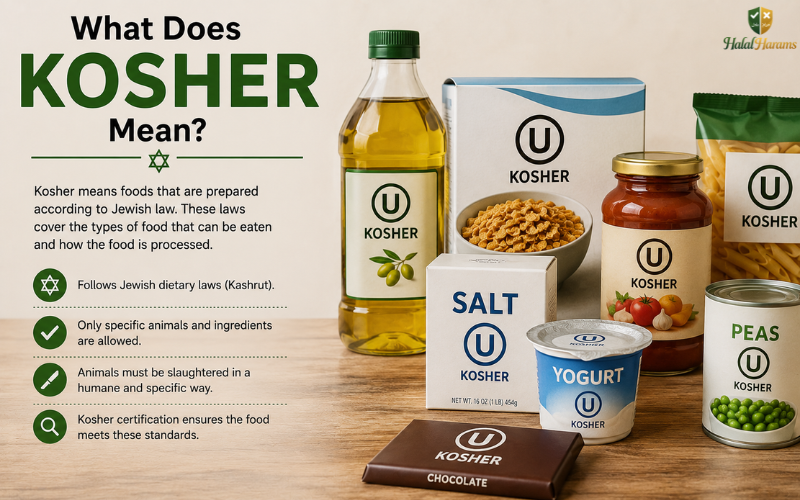
Kosher is a Hebrew term meaning fit or proper according to Jewish dietary laws (Kashrut).
Kosher food rules include:
- Only certain animals are allowed
- Animals must be slaughtered in a specific way (Shechita)
- Separation of meat and dairy
- No consumption of blood
- No pork or shellfish
👉 At first glance, kosher and halal appear very similar.
Similarities Between Halal and Kosher
Both systems emphasize purity, cleanliness, and ethical treatment of animals.
Key Similarities
| Aspect | Halal | Kosher |
|---|---|---|
| No pork | ✅ Yes | ✅ Yes |
| No blood | ✅ Yes | ✅ Yes |
| Ethical slaughter | ✅ Yes | ✅ Yes |
| Cleanliness | ✅ Yes | ✅ Yes |
| Permissible animals | ✅ Yes | ✅ Yes |
👉 These similarities are why many people think kosher may be halal.
Key Differences Between Halal and Kosher
Despite similarities, there are important differences.
Key Differences
| Aspect | Halal | Kosher |
|---|---|---|
| Name of God | Must mention Allah | Jewish blessing recited |
| Slaughter method | Zabiha | Shechita |
| Alcohol | Strictly prohibited | Permitted in some cases |
| Seafood | Mostly all allowed | Limited types only |
| Mixing dairy & meat | Allowed | Not allowed |
👉 These differences affect whether kosher food can be halal.
Is Kosher Meat Halal?
This is the most debated issue.
Islamic Perspective
In Islam, meat is halal if:
- Slaughtered by a Muslim, Christian, or Jew (People of the Book)
- Allah’s name is mentioned
- Proper method is followed
Some scholars argue:
- Kosher meat may be permissible because Jews are People of the Book
However, others argue:
- The name of Allah is not mentioned
- The method differs slightly
- Modern practices may not meet halal standards
👉 Because of this, opinions differ.
Related Post: Are Oreos Halal
Scholarly Opinions on Kosher Meat
Scholarly Views
| Opinion Type | View |
|---|---|
| Permissible | Kosher meat is halal (People of the Book) |
| Cautious | Allowed only if conditions are verified |
| Strict | Not halal due to differences |
👉 Most contemporary scholars lean toward caution.
Slaughter Methods: Zabiha vs Shechita
Understanding slaughter methods helps clarify the issue.
Zabiha (Islamic Method)
- Name of Allah must be recited
- Sharp knife used
- Throat, windpipe, and veins cut
- Blood drained
Shechita (Jewish Method)
- Blessing is recited (not necessarily Allah’s name)
- Sharp knife used
- Similar cutting process
- Blood drained
👉 While similar, the religious intention differs, which is important in Islam.
Alcohol in Kosher vs Halal
Alcohol is another major difference.
Alcohol Rules
| Aspect | Halal | Kosher |
|---|---|---|
| Alcohol | ❌ Forbidden | ✅ Allowed in some forms |
| Wine | ❌ Haram | ✅ Kosher wine allowed |
👉 This makes many kosher products unsuitable for Muslims.
Processed Foods: Are Kosher Products Halal?
Kosher certification is often found on packaged foods. But this does not automatically make them halal.
Kosher products may contain:
- Alcohol
- Non-halal enzymes
- Ingredients not permissible in Islam
👉 Always check ingredients carefully.
When Kosher Food May Be Halal
Kosher food may be considered halal when:
- It contains no haram ingredients
- No alcohol is present
- It is plant-based
- No cross-contamination occurs
👉 Example: Kosher-certified bread or vegetables.
When Kosher Food Is Not Halal
Kosher food is not halal when:
- It contains alcohol
- It includes non-halal meat
- Slaughter method does not meet Islamic requirements
- Ingredients are doubtful
👉 Meat is the most critical concern.
Practical Guidance for Muslims
If you are unsure, follow these steps:
- Check ingredient labels
- Avoid doubtful meat products
- Look for halal certification
- Choose vegetarian options if needed
- Consult scholars if necessary
👉 These steps help ensure compliance.
Common Misconceptions
“Kosher and halal are the same”
They are similar but not identical.
“Kosher meat is always halal”
Not according to most scholars.
“Kosher certification is enough”
Not for strict halal requirements.
Why This Topic Matters
Understanding kosher vs halal is important because:
- Many Muslims live in non-Muslim countries
- Kosher food is widely available
- It helps avoid doubtful or haram food
Related Post: What Does Halal Food Mean? Complete Guide(2026)
FAQs
Is kosher halal?
Kosher is not automatically halal. Some foods may be permissible, but differences exist.
Can Muslims eat kosher meat?
Scholars differ, but many recommend avoiding it unless verified.
Is kosher slaughter the same as halal?
It is similar but not identical, especially in religious requirements.
Are kosher products halal?
Some may be, but not all—ingredients must be checked.
Is kosher wine halal?
No, alcohol is haram in Islam.
What is the safest option?
Choosing halal-certified food is the safest.
Final Remarks
Kosher and halal dietary systems share many similarities, including the prohibition of pork, the requirement for ethical slaughter, and the emphasis on cleanliness and purity. However, they are not identical. Key differences—such as the requirement to recite the name of Allah during slaughter and the prohibition of alcohol in Islam—mean that kosher food is not automatically halal. While some kosher products, especially plant-based ones, may be permissible, kosher meat remains a debated issue among scholars. For Muslims who wish to strictly follow halal guidelines, it is best to choose halal-certified food whenever possible and avoid doubtful items. Staying informed and cautious ensures that your dietary choices align with Islamic teachings.
