
Introduction
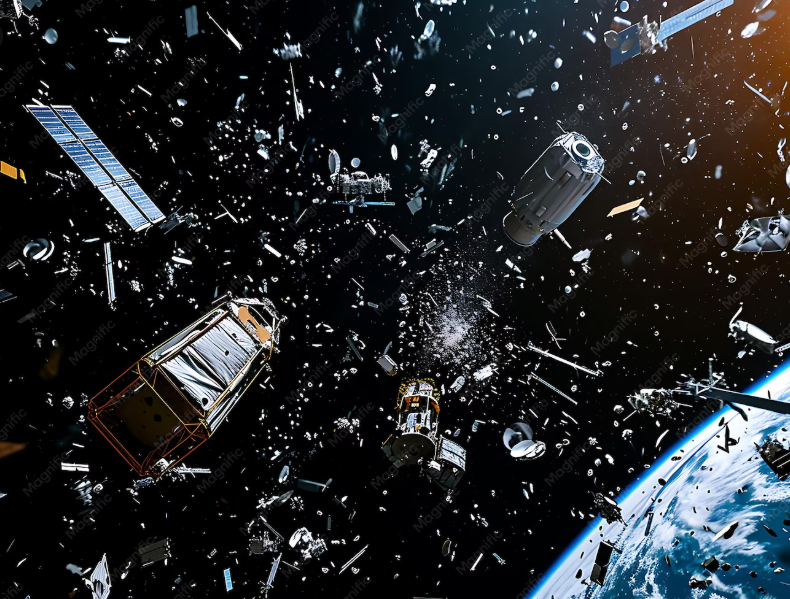
Earth’s orbit is becoming increasingly crowded with operational satellites, abandoned spacecraft, rocket components, and fragments from previous collisions. As commercial space activities expand, managing orbital debris has become an important challenge for governments, satellite operators, and international organizations.
One particularly complicated question arises when a decommissioned satellite collides with another spacecraft: Who is responsible for the damage?
Although international space law establishes principles of liability, determining fault in orbital collisions can be difficult. Understanding these rules is essential for protecting space infrastructure and encouraging responsible satellite operations.
Understanding Space Debris and Orbital Collisions
Space debris refers to human-made objects in orbit that no longer serve a useful operational purpose.
Common examples include:
- Decommissioned satellites.
- Discarded rocket stages.
- Fragments from spacecraft explosions.
- Components released during missions.
- Debris created by satellite collisions.
Even relatively small fragments can cause significant damage because objects in orbit may travel at extremely high relative speeds.
A collision can disable operational satellites and generate additional fragments, increasing risks for other spacecraft.
The International Legal Framework for Space Liability
International responsibility for damage caused by space objects is primarily addressed through the 1967 Outer Space Treaty and the 1972 Liability Convention.
These agreements establish obligations for states involved in launching and operating space objects.
Under the Liability Convention, a launching state may be responsible for damage caused by its space objects, including objects that are no longer operational.
However, the applicable liability standard depends on where the damage occurs.
Absolute Liability vs. Fault-Based Liability
International space law distinguishes between damage occurring on Earth and damage occurring in space.
Absolute Liability for Damage on Earth
A launching state is generally absolutely liable for damage caused by its space object on Earth’s surface or to aircraft in flight.
This means the injured party does not ordinarily need to prove negligence to establish liability.
Fault-Based Liability in Outer Space
When one state’s space object damages another state’s space object in orbit, liability generally depends on proving fault.
The claiming state must establish that the damage resulted from the fault of the other launching state or persons for whom it is responsible.
This distinction creates significant challenges when collisions involve abandoned satellites or untracked debris. unoosa.org+1
Who Is Responsible for a Decommissioned Satellite?
A satellite does not automatically lose its legal connection to its launching state when it stops functioning.
Under international space law, launching states retain relevant responsibilities associated with objects they place into space.
A launching state may include a country that launches an object, arranges its launch, or provides the territory or facility from which it is launched.
Consequently, multiple countries may qualify as launching states for one satellite.
The involvement of commercial companies does not automatically eliminate governmental responsibility.
However, establishing liability for an orbital collision still requires consideration of the applicable legal rules and evidence of fault.
Challenges in Proving Fault
Determining responsibility for space debris collisions is considerably more complicated than investigating ordinary transportation accidents.
Identifying the Debris
Small fragments may be difficult to track or associate with their original spacecraft.
Without reliable identification, determining which launching state is involved becomes challenging.
Establishing Negligence
A collision does not automatically demonstrate that a satellite operator acted negligently.
Investigators may need to examine available collision warnings, orbital tracking information, spacecraft capabilities, and accepted operating practices.
Evaluating Historical Conduct
Some abandoned satellites were launched decades ago, before contemporary debris mitigation practices became widespread.
Assessing whether their operators acted irresponsibly requires consideration of the circumstances and obligations relevant to the incident.
The Role of Satellite Registration
The Registration Convention provides an international framework for recording information about objects launched into outer space.
Registration supports transparency and helps identify the states associated with particular spacecraft.
Relevant information includes identifying details and basic orbital characteristics.
However, registration alone does not establish liability or prove fault.
It primarily helps investigators connect space objects with their launching states. unoosa.org
Can Commercial Satellite Operators Be Held Financially Responsible?
Commercial companies operate a growing share of modern satellite infrastructure.
Although the Liability Convention primarily establishes claims between states, private companies may face financial consequences through national legislation, licensing requirements, insurance arrangements, and contractual obligations.
For example, governments may require satellite operators to maintain insurance or comply with debris mitigation conditions.
Depending on national law, a state that pays compensation might also seek reimbursement from a private operator.
These arrangements vary between jurisdictions and do not automatically determine international responsibility.
Insurance and Financial Risk Management
Satellite insurance can provide financial protection against certain operational risks.
Coverage may address launch failures, spacecraft damage, or losses occurring during orbital operations.
However, policies differ in their treatment of collisions, debris damage, exclusions, and third-party liability.
As orbital congestion increases, insurers and operators must evaluate collision probabilities and potential financial exposure.
Clearer risk assessments may encourage improved satellite design and responsible end-of-life planning.
Preventing Future Space Debris Disputes
Reducing orbital debris is essential for limiting future collisions and legal disagreements.
Important prevention strategies include:
- Designing satellites with reliable disposal capabilities.
- Moving suitable spacecraft into designated disposal orbits.
- Safely deorbiting satellites when appropriate.
- Improving collision monitoring and communication.
- Avoiding unnecessary debris-producing activities.
- Developing technologies for active debris removal.
International cooperation is particularly important because debris created by one mission can threaten spacecraft operated by many countries.
Conclusion
Determining who pays when decommissioned satellites collide involves complex questions of international responsibility, fault, and compensation.
The Liability Convention provides an important legal foundation, but proving fault in orbital collisions remains challenging, especially when debris cannot be reliably identified.
As space activities expand, stronger debris mitigation practices, transparent registration, effective tracking, and international cooperation will become increasingly important.
Protecting Earth’s orbital environment requires more than assigning financial responsibility after accidents. It also requires preventing avoidable collisions before they happen.
Read More : Algorithmic Bias Audits: Holding Automated Hiring Tools Legally Accountable
